We shipped too many upgrades to squeeze them into a single post, so this is part 1 of 3 of what's new for GitClear users. We'll publish a blog post every week or two through the end of the year, starting here with Diff Digest, File Blame, and the code that survives after AI writes it.
As always, the north star hasn't moved: every number GitClear reports should be one you can drill into, audit, and defend. With our telemetry packages, every pull request review will let you understand which lines came from Opus/Astra, from the developer, and from your collaboration with your favorite LLM.
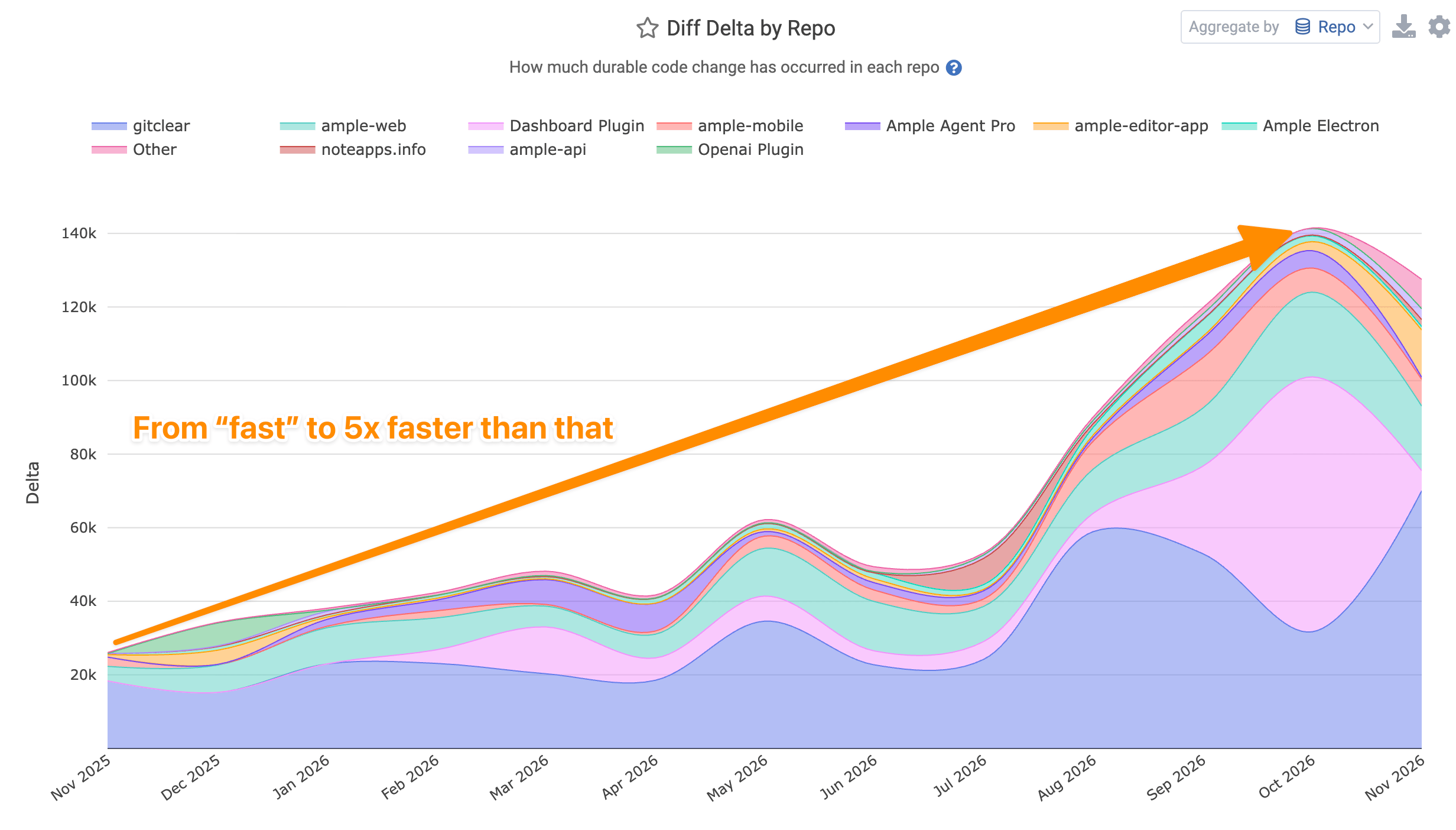
Like most of the software world, our productivity has surged this year. Unlike most, we can quantify it
linkHeadlining Features
The biggest updates in a big quarter.
link🖥️ Headliner #1: Diff Digest v1
The premise behind Diff Digest is uncomfortable but hard to argue with: if AI has made writing code roughly free, then the constraint on shipping has moved to the one part of the process that didn't get faster. Someone still has to read it.
Diff Digest v1 for macOS shipped this quarter, with its own download page, a configurable capability matrix comparing best git diff viewers:
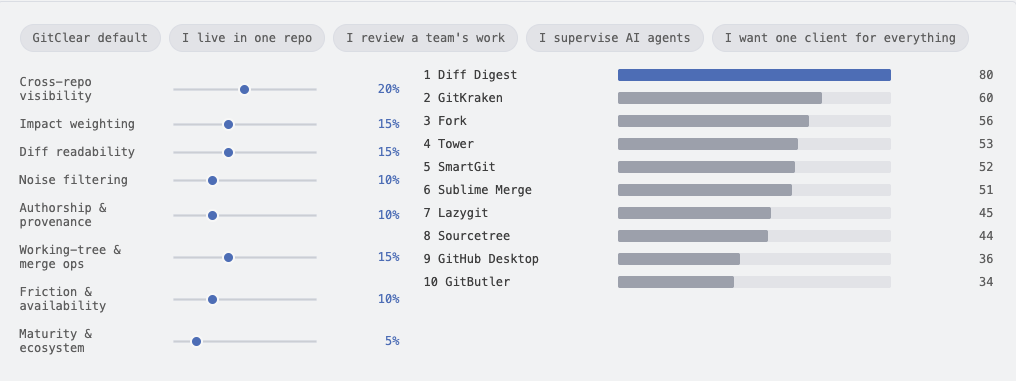
And, as of late August, a working download, the preponderance of evidence suggests that you won't find a better git client if you're looking for an AI-native view of what's changing in your repo.
What can Diff Digest do for you?
linkReview Depth: Because there just ain't time to review everything
A new slider that controls how many files a review opens. "Review depth," describes what you're choosing. Scope a review to fewer files when you want a fast pass, widen it when the change deserves one.
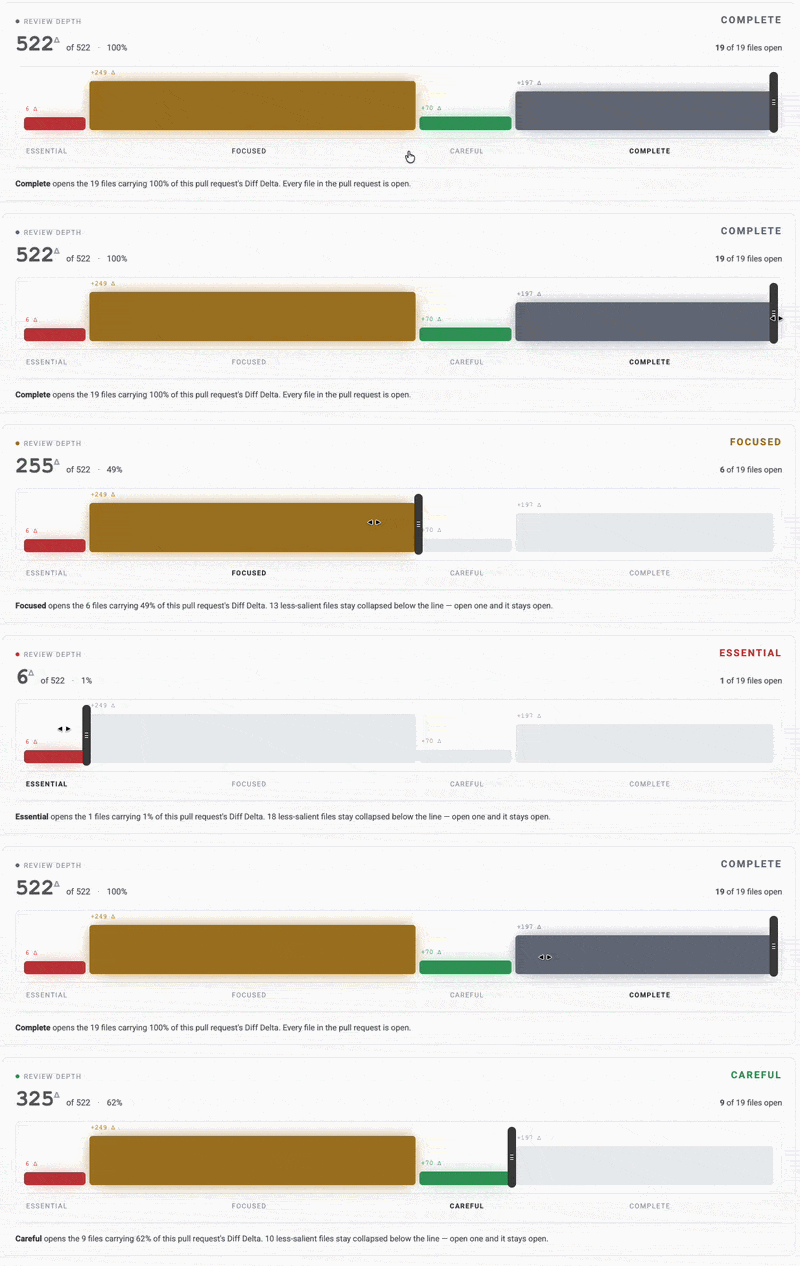
Customize the depth of your review by skipping less important files
Read more about the depth control on our PR review help page.
linkFiles ordered by how much they matter
The code category detector now carries salience tiers, across four levels, spanning autogenerated files, devops, docs, tests, directories and file types. That salience feeds reviewer-priority estimation, so a review starts on the files most likely to hurt you, rather than on a 4,000-line lockfile diff.
linkPRs awaiting review, in the tray
The menu bar tray now shows what's waiting on you, which is the difference between a review tool you open and a review tool that tells you when to open it.
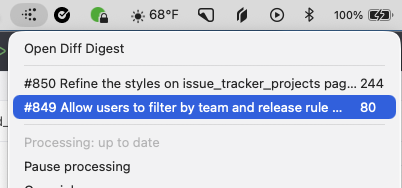
Pull requests awaiting your review, after logging in to Diff Digest
linkReview local repos without content reaching GitClear
Diff Digest can now read directories straight off your disk as a source of repos to process — pick root folders to import from, and a new local-git layer handles branches, commit SHAs, commit metadata, and patch text with lazy inspection. Offline commit processing is underway.
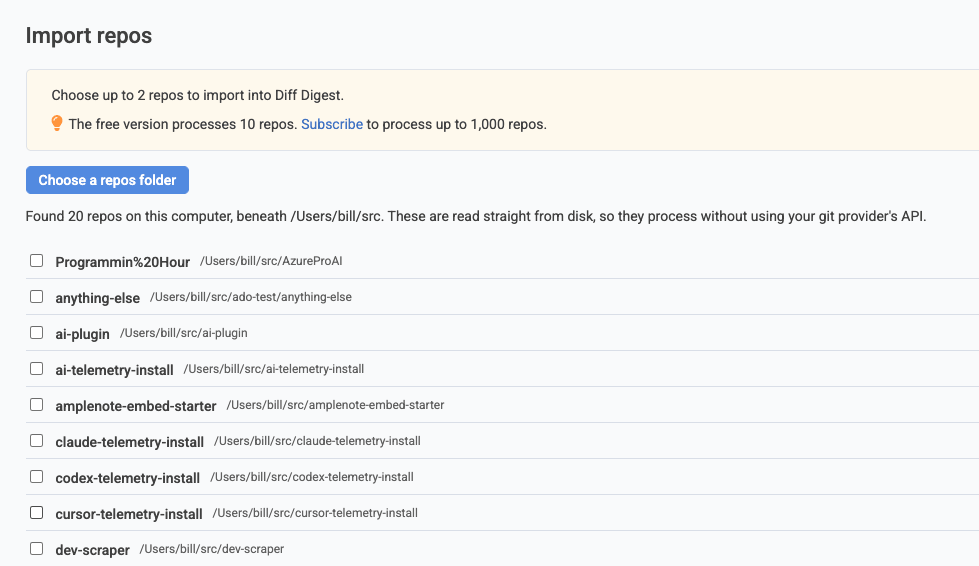
Community (free) edition of Diff Digest allows 10 repos to be processed off disk
linkFaster, and free for limited use
Commit processing time dropped to roughly a third of what it was a week earlier, and new commits are now prioritized when the app launches so the freshest work is processed first. Launch catch-up runs on startup with a visible progress component, and there's a Job Queue window in the menu for anyone who wants to watch the gears turn.
Feature | Free version | Pro/Lifetime version |
Repos processed | Up to 10 | Up to 1,000 |
Active developers' work processed | Up to 25 | Up to 200 |
Maximum commits processed | 2,000 + recent commits | 450,000 commits |
Maximum pull requests processed | 150 + recent PRs | 100,000 PRs |
Max history interval | 1 year | 15 years |
Synced pull request review | 🚫 No | ✅ Yes |
Commits grouped by theme | 🚫 No | ✅ Yes |
LLM authorship attribution | 🚫 No | ✅ Yes |
To enable LLM authorship attribution, install the AI telemetry npm package.
link🧱 Headliner #2: Databricks & Astronomer-based LLM/Commit Authorship Available
Thanks to a large new customer, GitClear has built a special version of the Enterprise Docker client for enriching data from bronze Databricks tables.
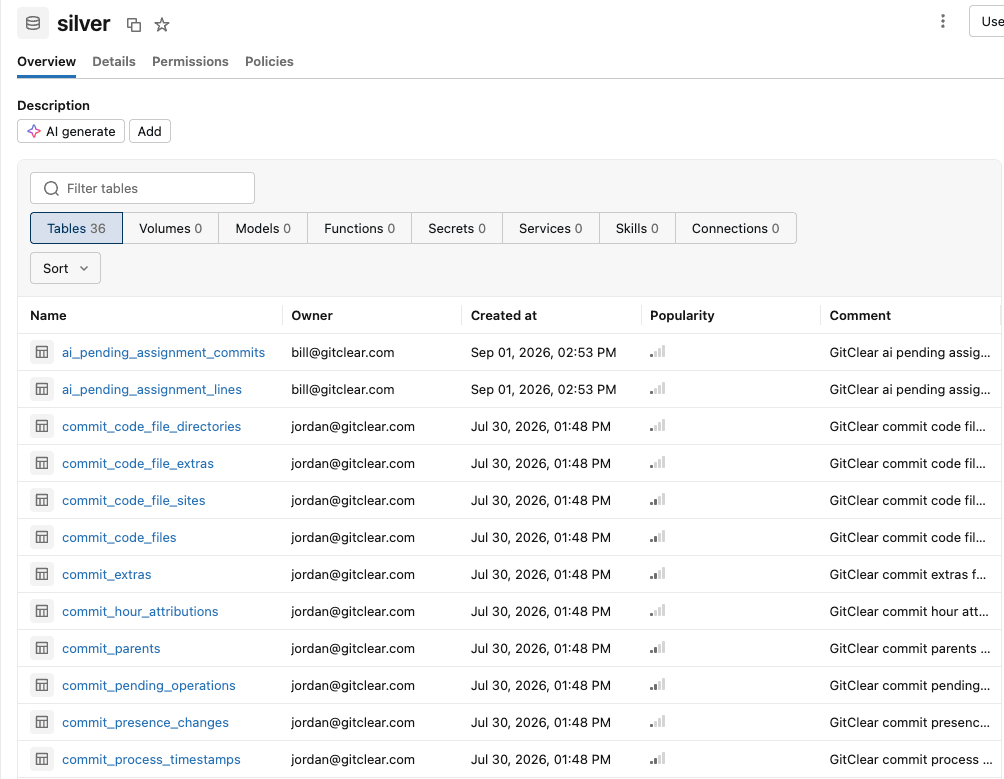
A small sample of more than 200 data tables that GitClear can provide
If you are a member of an Enterprise team that wants to put together all the puzzle pieces for how "individual commits" map on to "LLM authored work." We can open the door to help Enterprise customers understand which LLM models are being used by the team, and how the various models compare in terms of their churn, hotfix-propensity, and overall velocity.
We can also help answer questions like "How much value has been created by the code that AI has generated for various teams?"
If you have terabyte-scale data that you want processed in your own environment, with a perpetual use license, drop us a line at hello@gitclear.com
link📉 Headliner #3: LLM model durability curves
Token leaderboards tell you how much a model generated. They tell you nothing about how much of it survived contact with a code review.
The LLM (Model) Scorecard now computes and charts a durability funnel per model: Generated → Committed → PR merged → Deployed → Extended life. Because there is no truer indication of which model understood your prompt than the one whose code is still around months after deploy.
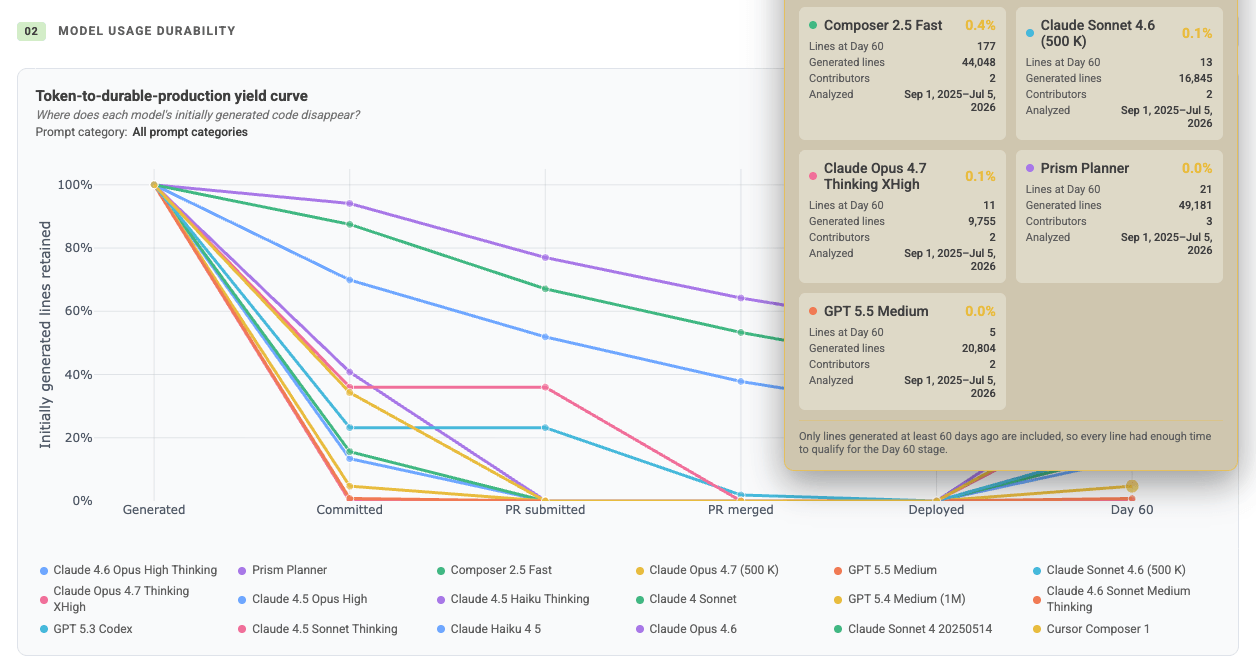
Which models wrote code that you kept: through commit, through PR, through deploy?
The curves come with tooltips built for comparison rather than decoration.
This is the natural extension of the Diff Delta premise. Once a line is attributed to a model, it gets scored for durability on the same basis as every other line in the repo. The durability curve is what that scoring looks like when you plot it over a model's whole output.
link📄 Headliner #4: New AI Code Quality Research (free PDF download)
We've released our latest annual 2026 AI Code Quality report, The Maintainability Gap, which follows the specific, quantifiable differences in how code is changing in the LLM era.
linkBig Upgrades & New Releases
Beyond the headliners, we've got a healthy crop of new goodies for subscribers.
link🎯 Cursor telemetry, at the prompt granularity
Cursor joins the roster of providers measured through a dedicated telemetry package that can track AI authorship down to the code line. The new package captures fine-grained Cursor prompt stats, with a served endpoint, build-label banner, and enterprise host rewriting, and the installer commands moved to @gitclear/ai-telemetry-install for install and update alike. Available now at https://www.gitclear.com/ai_telemetry_js
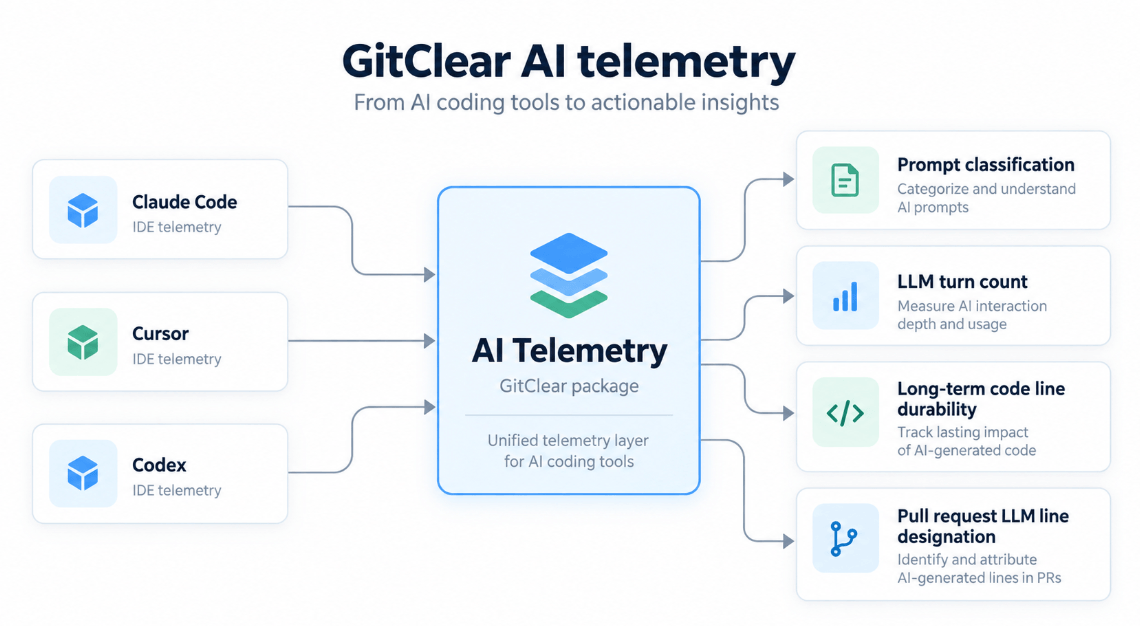
Now available via npx: Telemetry agents that go beyond Otel to capture what matters
This is how we are able to analyze which models specialize at which types of tasks, which fuels the Model ROI matrix that we'll be discussing in part 2.
link🤖 Review bots become a measurable quality signal
If an LLM is leaving comments on your pull requests, that's a code quality signal, and it's now measured as one. GitClear tracks LLM commenters via two new stats — review_comment_resolved_percent and review_comment_eligible_volume — and the weekly AI code quality signal graphs can now pivot by review-bot vendor.
The practical question this answers: when a review bot flags something, does anyone fix it? A bot with high comment volume and low resolution percentage is generating noise, not quality.
link📏 How many PRs are over 1,000 lines?
Our new AI industry stat charts track the percentage of pull requests exceeding 1,000 lines of Diff Delta, with a backfill task that computes it historically so the trend line starts with actual history rather than from today. Weekly cached stats cover prs_over_1k_percent and its eligible volume.
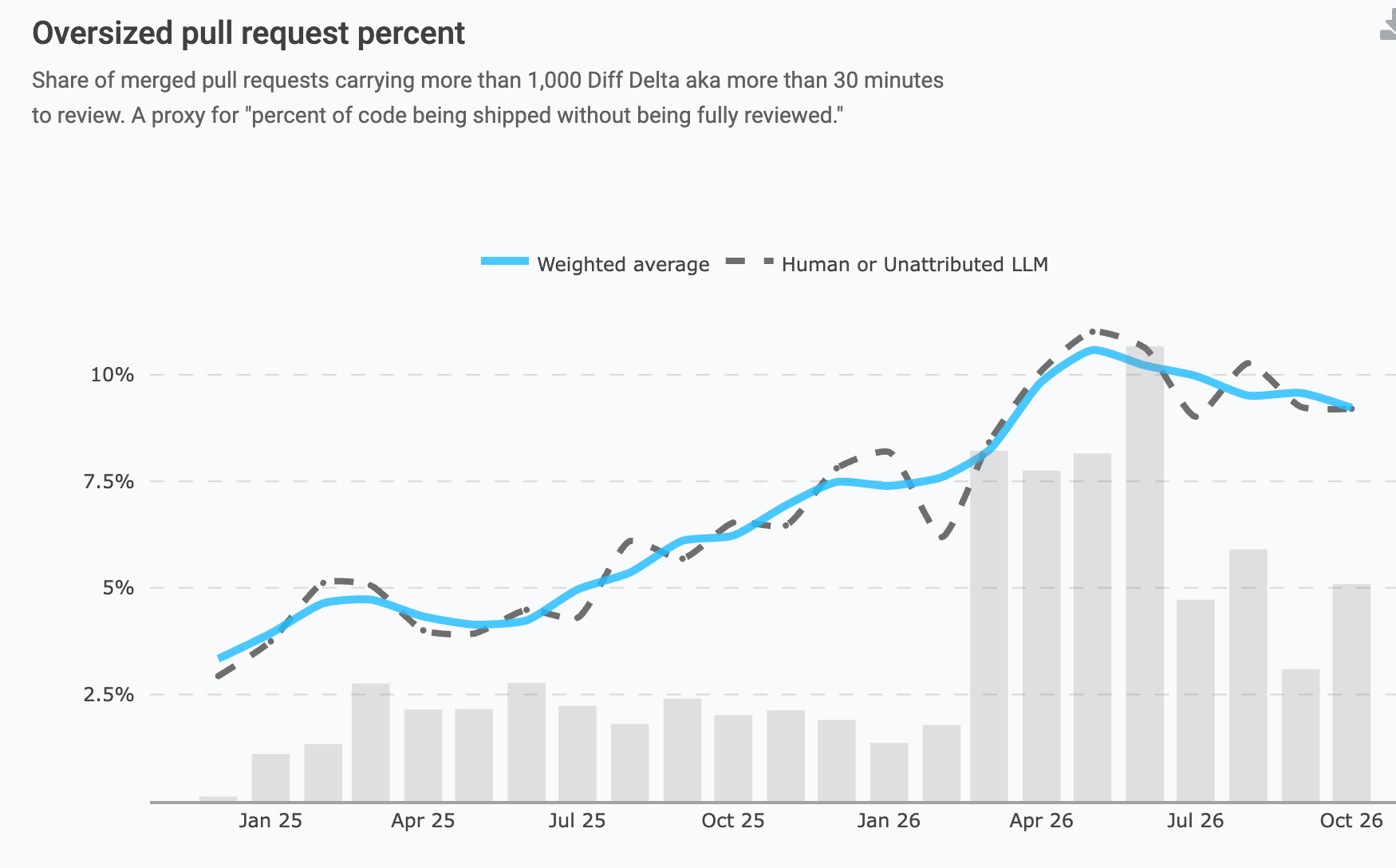
AI Code Quality graphs show that about 3x more PRs are now effectively unreadable
We think this one gets interesting as AI-authored volume climbs. A rising share of enormous PRs is one of the more legible ways that "AI made us faster" turns into "nobody can review this."
link🫧 Commit Activity Browser upgrades
The bubble view got a batch of usability work:
Groups travel together. Bubble collision handling now allows proximal placement for members of a group, and dragging a commit brings its group along with it.
Crowded cells auto-scale. When a committer-and-date cell's bubbles would overflow the space available, radii are halved automatically (area drops to a quarter), which keeps dense weeks readable instead of a solid mass of overlapping circles.
Streaming respects your filter. Incoming commits from committers outside the current CAB filter are now ignored, so a filtered or single-developer view stops getting repainted with commits that don't belong in it.
Changed-file glimpse, colorized. The changed-file glimpse in group and commit views is now colorized, with a mini-summary on hover.
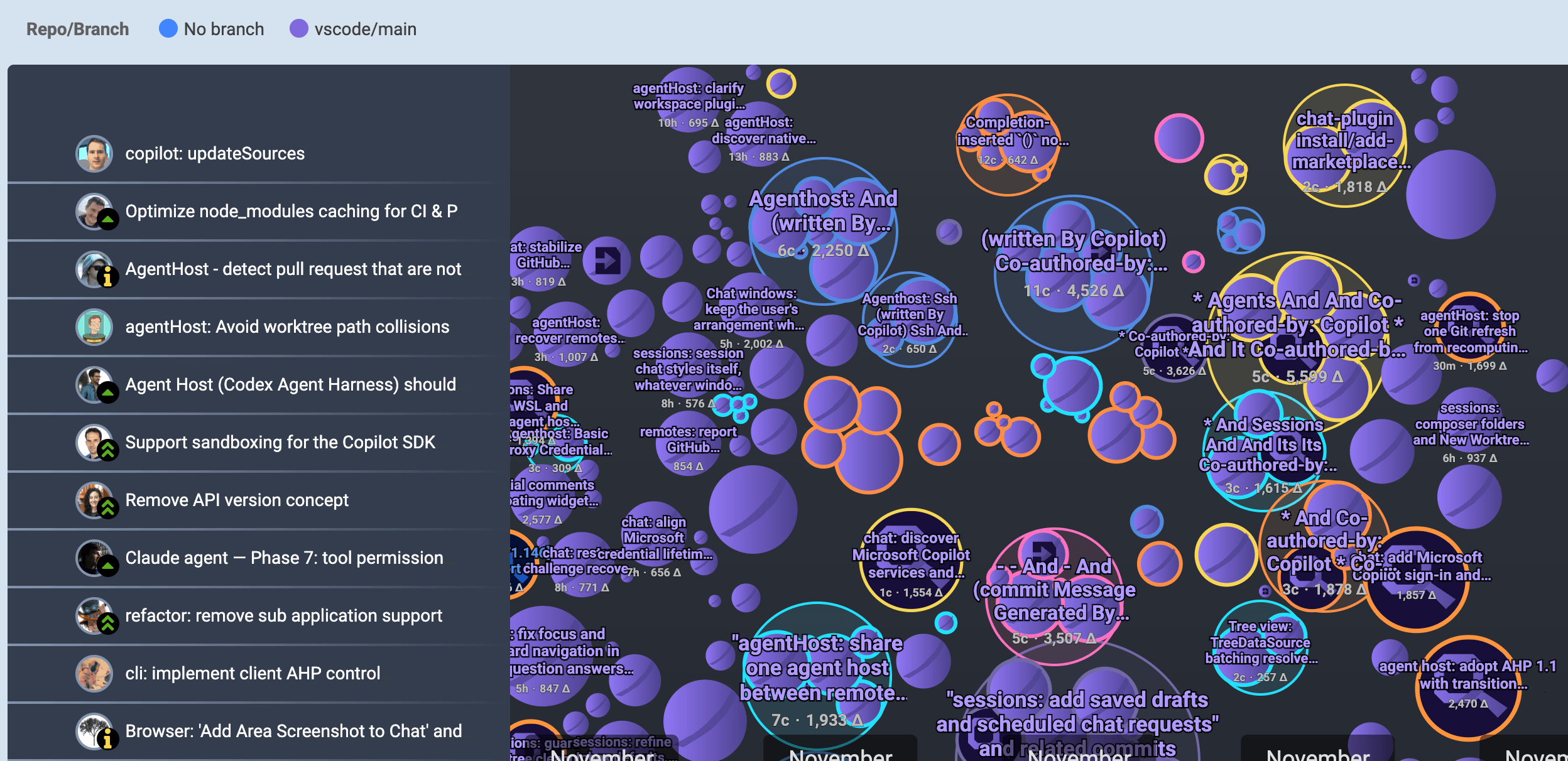
The new default for Commit Activity Browser labels groups before you click
For large repos like Microsoft VS Code, this is the only possible way to make sense of the teeming commit history.
link📡 Snap Changelogs publish to Atproto
The automated changelogs that power this blog post can now publish committer entries to a social stream via an AtprotoAccount. Connect an account, set a repo allowlist, and shipped work posts itself. Metadata-only changes are guarded so an edit doesn't trigger a re-publish loop.
link🎫 AI-derived issue matching for closed PRs
When a PR closes without citing an issue, GitClear now queues an AI fallback that derives the likely match and shows its rationale, with an "Unassign ticket" action for when it guesses wrong. Better than a blank field, and honest about being an inference.
link📊 New AI usage metrics
The AI Usage stats view picked up several additions this quarter:
Diff Delta per composite token consumed — a v1 efficiency metric that puts durable output over spend.
AI code-line percentage, per-provider inactive counts, per-LLM Diff Delta, and a detailed token breakdown (cached vs. uncached, input vs. write).
AI-Assisted Commit percentage and cumulative token count, both now in the default view.
link🔍 File Blame, or walking a file backward through time
git blame answers one question: who last touched this line? It is silent on the more useful question, which is how did this line come to be.
The Directory Browser now retrieves file contents, which makes it possible to browse back through a file's lineage inside GitClear. v1 shipped in August with a snapshot summary, a loading state, and a "Return to latest" action for when you've wandered far enough back that you'd like to come home. The presenter paginates per-line fetching, so the view scales to files that are large enough to be interesting.
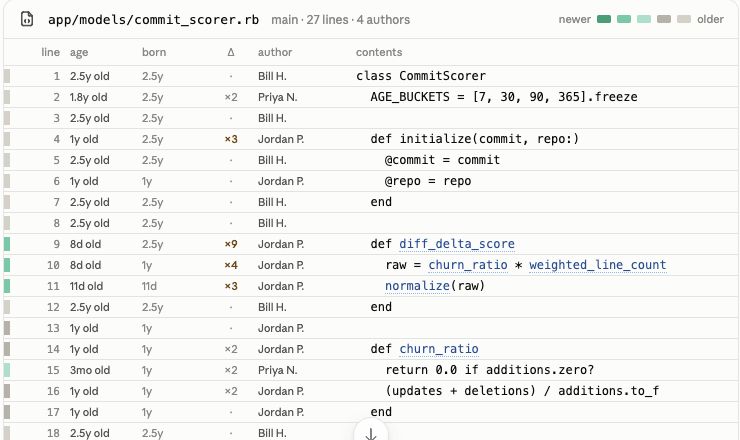
Understand how a file came to be — now available as part of Diff Digest.
This was the most-loved changelog entry of the quarter, which we're taking as a signal to keep going. There's more coming here: see What's Next.
link🔮 What's Next?
Last quarter's post promised AI Code Quality dashboards by mid-June. Those landed, and the signal graphs have been accumulating history and getting their tooltips corrected ever since.
In Part 2, we'll turn from how much code survives to how teams can choose the right model for each task: AI adoption and measurement coverage, the AI Scorecard's Task–Model ROI Matrix, and getting the telemetry in place to make those comparisons useful.
In Part 3, we'll return to the work itself: contextual answers during pull request review, deeper code-history navigation, and connecting enterprise AI activity to the outcomes that ship. There is plenty more to unpack, and we'll keep the updates coming every week or two through the end of 2026.
GitClear is a software engineering intelligence platform built around the Diff Delta metric, commit-level AI attribution, and one of the largest public code-quality research datasets in the category. Every stat is designed to be drilled into, audited, and defended. Questions? Email hello@gitclear.com.