It was 10 years ago that GitClear fired up the "Commit Crunching" machine. We're not going to claim that we got the implementation exactly right on our first try...
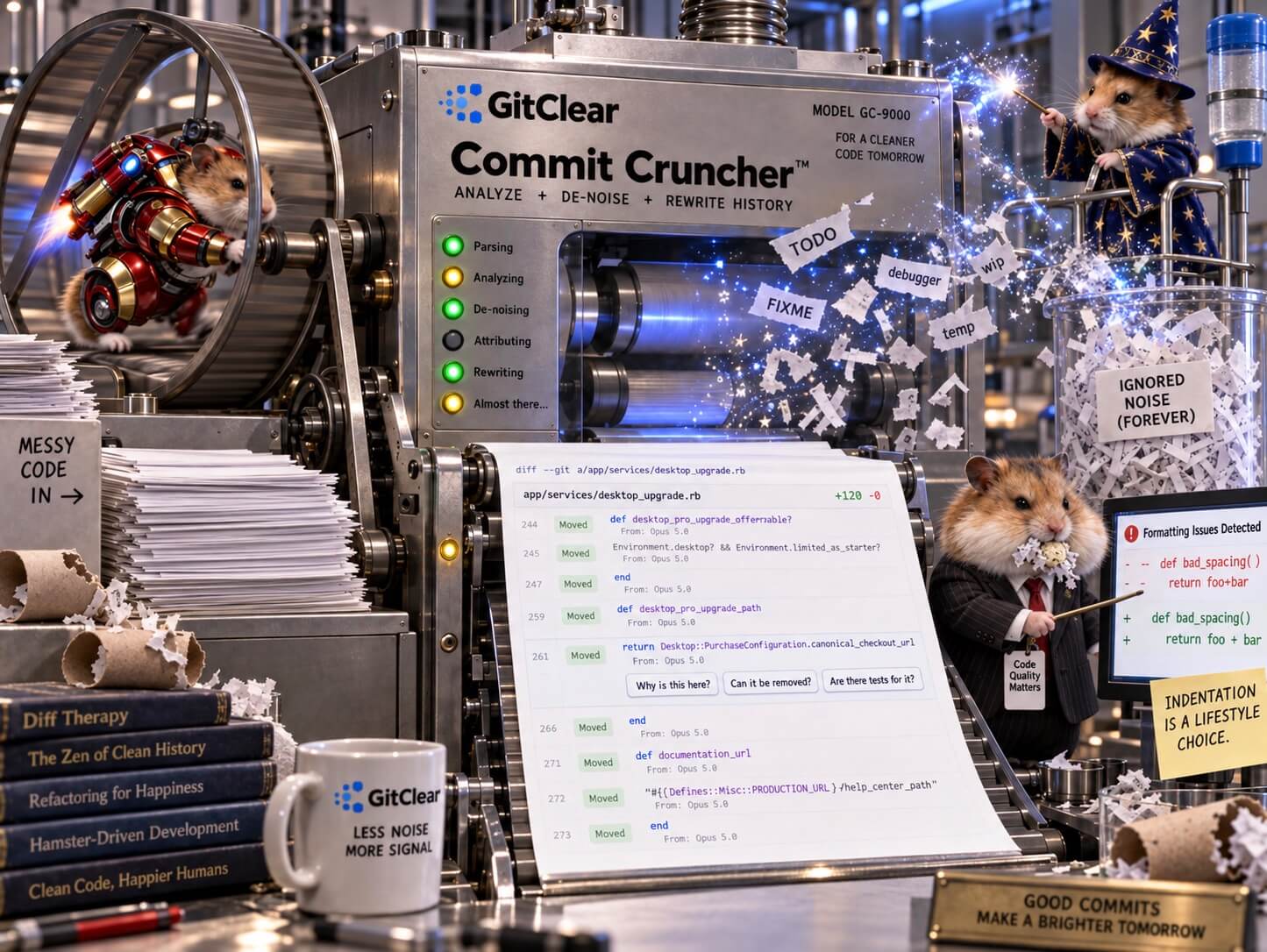
But after refining those early attempts, the Cruncher has gone on to lend its data to two of the most broadly-cited AI Code Quality reports (2024, 2025), thanks to its ability to distinguish Moved, Copy/Paste, Duplication and Keyword-labeled changes. Labeling each line by its method, and combining the lines into "Commit Groups" slowly progressed into a toolset that now saves us a lot of time reviewing code – a welcome side-effect.
This year, we hesitated to publish our annual AI Code Quality report. Partially, from the (imagined) pressure of producing a new set of change data that would spark as much discussion as our first two reports did (referenced by TechCrunch, MIT Technology Review, even ThePrimeTime). But equally, because this was the first year where it felt like, whatever we published, it was going to be instantly outdated. That is how fast these models are evolving in 2026.
Better late than never:
Today we are releasing a new batch of AI code quality research from 210 million analyzed lines.
We are also releasing an AI Code Quality Stats Dashboard that will be updated weekly, to keep up with this month's latest & greatest
And most unexpectedly, after 10 years of requiring a beefy server cluster to host our Commit Cruncher, today we're releasing a special version of GitClear that crams our code processing engine into an offline-first, downloadable Diff Viewing tool for any macOS (soon, Linux or Windows) system with 8gb of RAM.
Three releases, all a response to the same reality: the software development industry of 2026 bears little resemblance to 2025, and will bear little resemblance to 2027. Let's bend that qualitative statement into something more quantitative: What say thee, data?
link🎓 "Write-Only Mode" – 2026 AI Code Quality Research
The AI Code Quality research for 2026 is now available for free download for any logged in user (or anyone who validates their email address). It finds code reuse plummeting, while copy/paste and duplication (long-term maintenance warts) thrive:
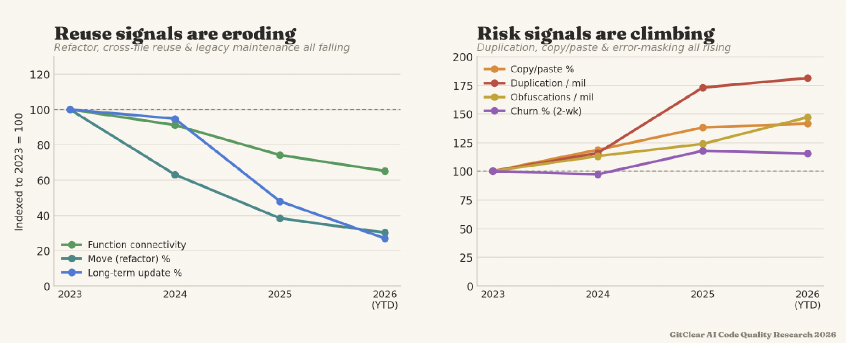
Long-term view of changes in code authorship
The bad news? This code is going to be something of a nightmare to maintain.
The good news? It won't be humans maintaining it. Still, the same forces that make it difficult for humans to reason about "unnecessary rescues" and to maintain code with "duplicative implementations" will make it cost a lot of tokens (with attendant uncertainties) for future LLMs to fix these problems. More sooner than later, teams need to take responsibility for the volumes of code spewing forth from the code fountains.
link📊 AI Code Quality Stats Dashboard
In 2026, life comes at ya fast. Stats from "a rolling 12 month window," like our Write-Only Mode research, are an instantly-aged snapshot of past model performance. The rate of new LLM releases has nullified any semblance of a "stable" environment to evaluate. So we adapt, and offer a new medley of AI code quality stats updated weekly. This has the handy side effect of letting us continue adding to the stats beyond what was analyzed in the research paper, for example, the percent of pull requests too large to review in one sitting:
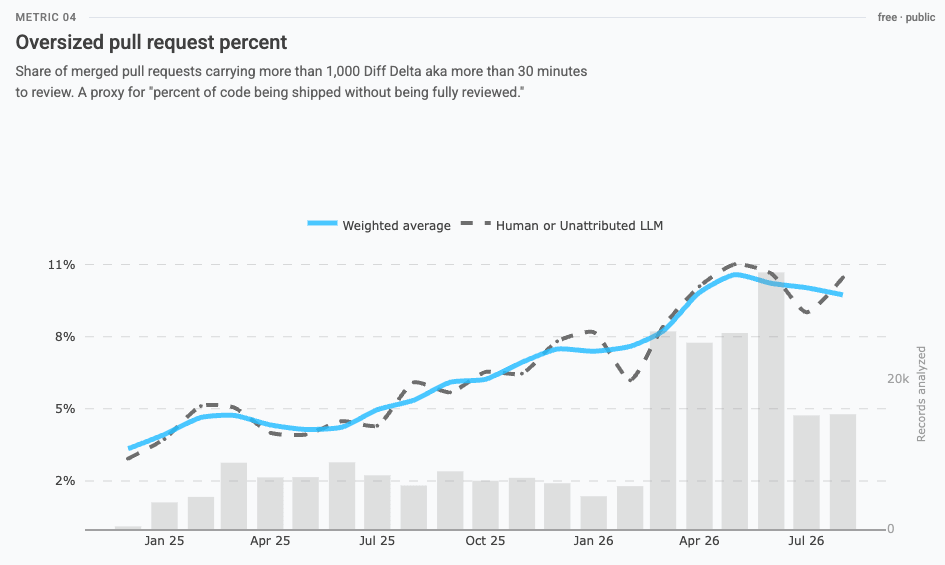
Technically, it is the percent of all pull requests with more than 1,000 Diff Delta
This graph is low-key amazing. It says that, over hundreds of thousands of PRs, the percent of pull requests that can't be reviewed in one sitting has more than doubled in the past year, to 11% of all opened PRs. To put 1,000 Diff Delta (the "PR size" threshold to qualify for this graph) in context:
Pre-AI, the median developer would accumulate about 1,000 Diff Delta every 2 week sprint
A PR with 1,000 Diff Delta has either 5+ large changes in legacy files, or 10+ large changes in new files
An experienced code reviewer averages 30-60 minutes to review a PR of this size
The AI Code Quality Stats Graphs are updated every week or so, have your LLM check how they're going periodically?
link🚒 Diff Digest: New tool for clarifying progress from a firehose
In many ways, the LLM code tools available to developers in 2026 transforms the rate at which progress can be made. Now, even a small team can make substantive commits across multiple repos within a single day. But how will managers and teammates know what is happening, when the default "git desktop" tool remains Github Desktop – a git viewing experience that shows one repo at a time.
With the rate that development now happens, we are going to need a better option. Enter Commit Activity Browser v5:
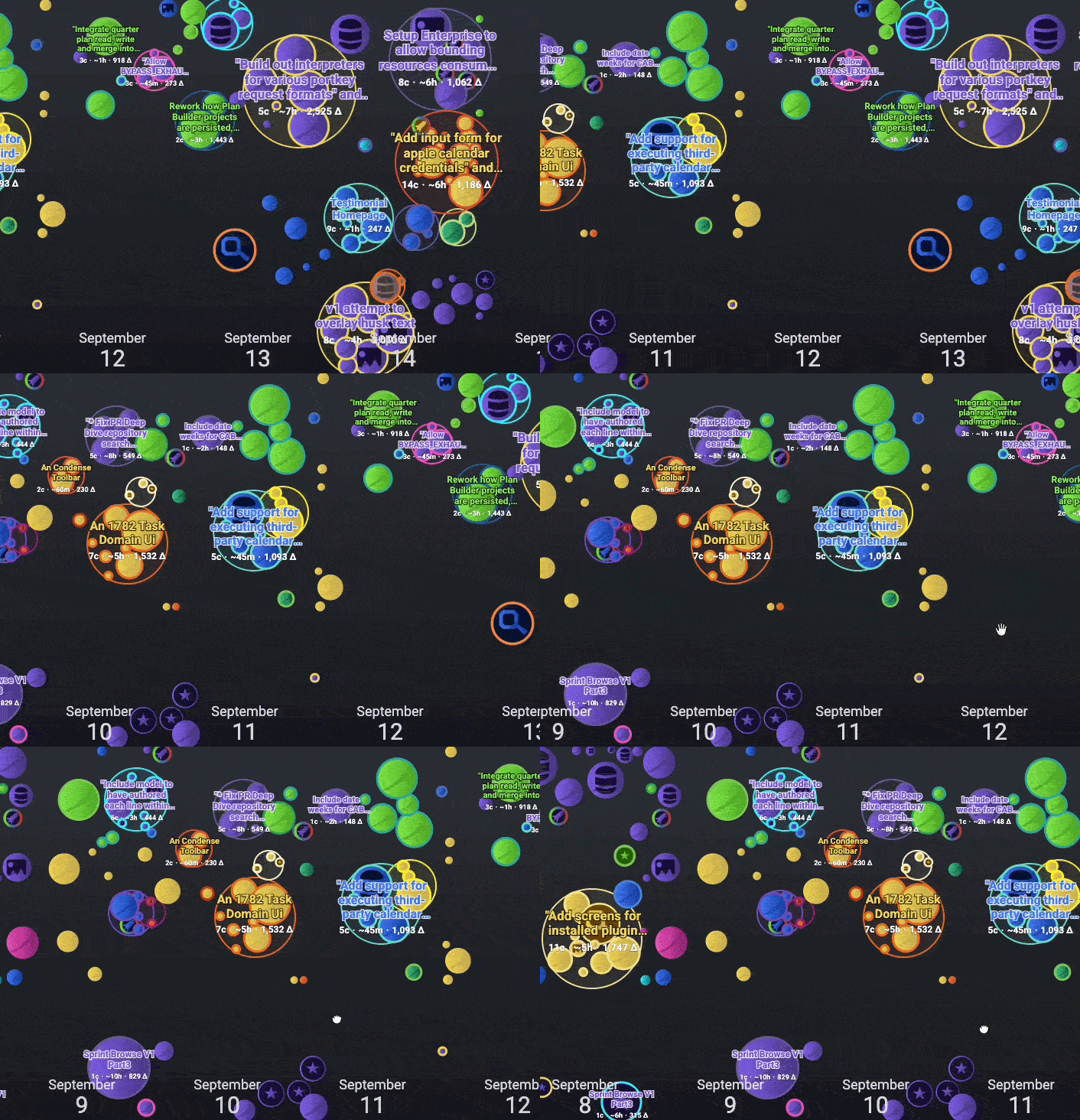
Each row in the graphic corresponds to one committer. You control how commits are colored.
GitClear's venerable window into commit history lays out all committers across all repos, now with a brief description of each commit group. As always, the size of the the circles communicates how much durable code was changed, and the color of the circles indicates the repo+branch in which the commit was authored.
For the first time, getting the benefit of grouped commits from across repos does not require trusting GitClear to store your code. All of this evaluation and generation can happen entirely on your local computer. No data transferred to GitClear besides subscription level.
link🗜️ Review depth: When time is limited, focus here
The fastest way to review code? Not to 🙃
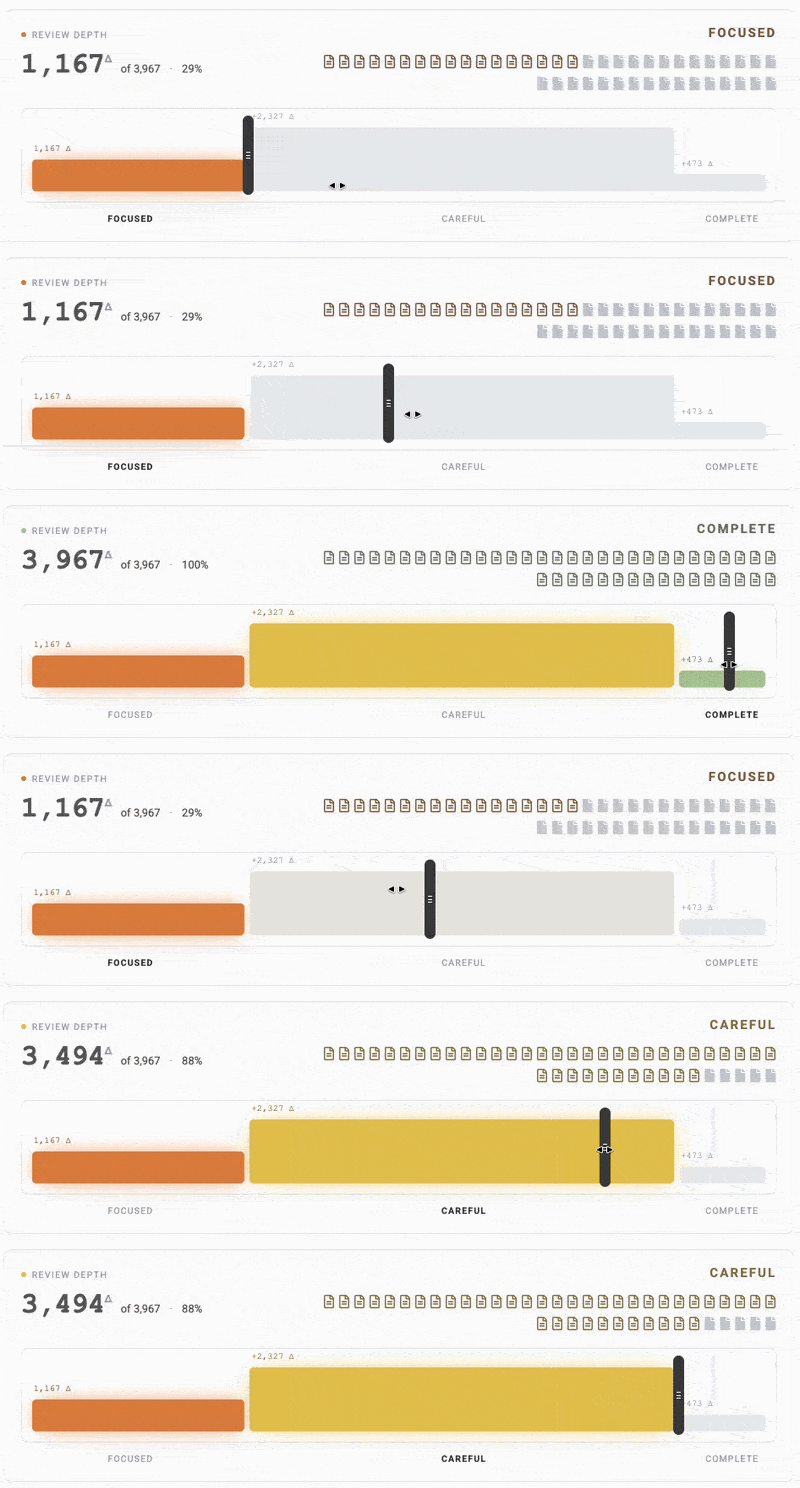
With GitClear's configurable "Review Depth" feature, we split different types of changes by how essential they are to review. Roughly speak, we conceptualize the salience tiers as:
🔴 Essential: Database migrations, dependency changes, substantial updates to legacy files, configuration file changes
🟠 Focused: Models, large controllers, most library changes, changes to trivial files that break convention, middleware, event/exceptions
🟡 Careful: Any other settings-changing work that wasn't captured by "Essential" or "Focused", most html/view files, factories, small controllers, documentation
🟢 Complete: Everything not covered above: Tests, compiled files (that aren't ignored)
Chances are, especially if the PR contains many test files authored by modern LLMs, that the Senior Developer does not need to carefully dissect every changed comment in a test file.
link🎁 Wrap-up
GitClear will continue to accumulate data to help contextualize how rapidly the industry is changing. Come for the data, stay for the tools to help you change along with it.
Download Diff Digest to try offline-first, local commit processing that syncs pull request review
Stay tuned in the coming week for a roundup of the most productive quarter in GitClear's long history...