To understand how AI is changing code quality, velocity, and other metrics, it's useful to start with a baseline for the relative degree to which AI is being used each year since its late-2022 launch. Since no organization or research group has surveyed a large number of developers with a consistent prompt, the best we can do to estimate AI adoption velocity is to splice together the high-N annual developer surveys since 2023. When developers are asked "Do you use, or plan to use, AI?" a steadily growing number responded in the affirmative: from 44% to 84% between 2023 and 2025.
But "plan to use AI" is a long way from being a daily AI user, and we're curious about both. So we've combined the 5000-foot question ("use or plan to use AI") with more granular queries, like "do you use AI Tools daily," which was first asked by the Stack Overflow Developer Survey in 2025. The latter criteria yields a smaller fraction of developers, but as of 2025, still clocks in at a substantial 51% of Professional Developers that report using AI Tools (of any sort) daily:
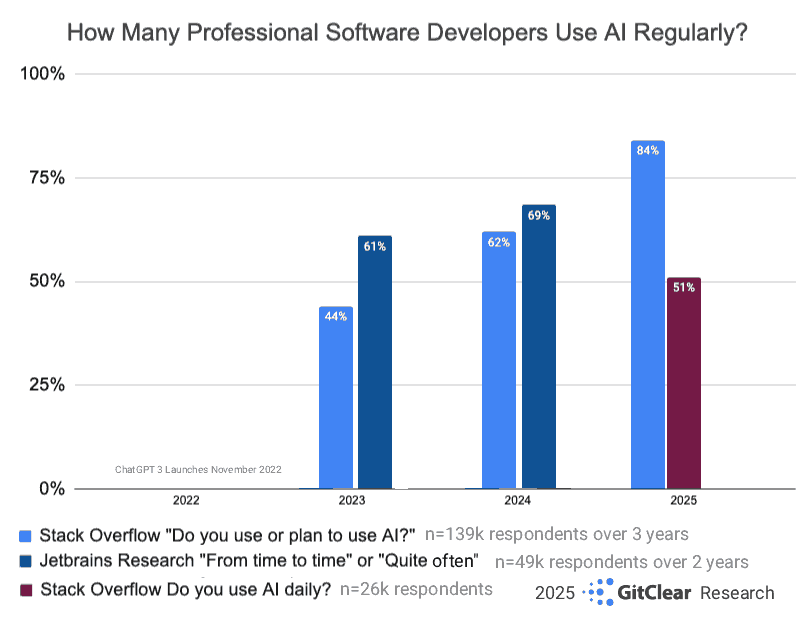
There is no single prompt used by a scaled annual survey. Best available is "Do you use, or plan to use, AI?"
As mentioned, this graph applies specifically to those who self-identify as "Professional Developers." What would a more granular breakdown look like? Do new programmers use AI Tools more often than Senior Developers, who are presumably more entrenched in routine?
Focuing on 2025's results, AI use among "All Respondents" was less than 10% different from AI use among "Professional Developers" (47.1% vs 50.6%). That is a relatively small gap, wherein Professional Developers use AI Tools only slightly more than all Stack Overflow users.
However, as a final odd twist, daily AI use is almost exactly as common among the "most experienced" developers as it is among the "generic Stack Overflow respondent." 🤔
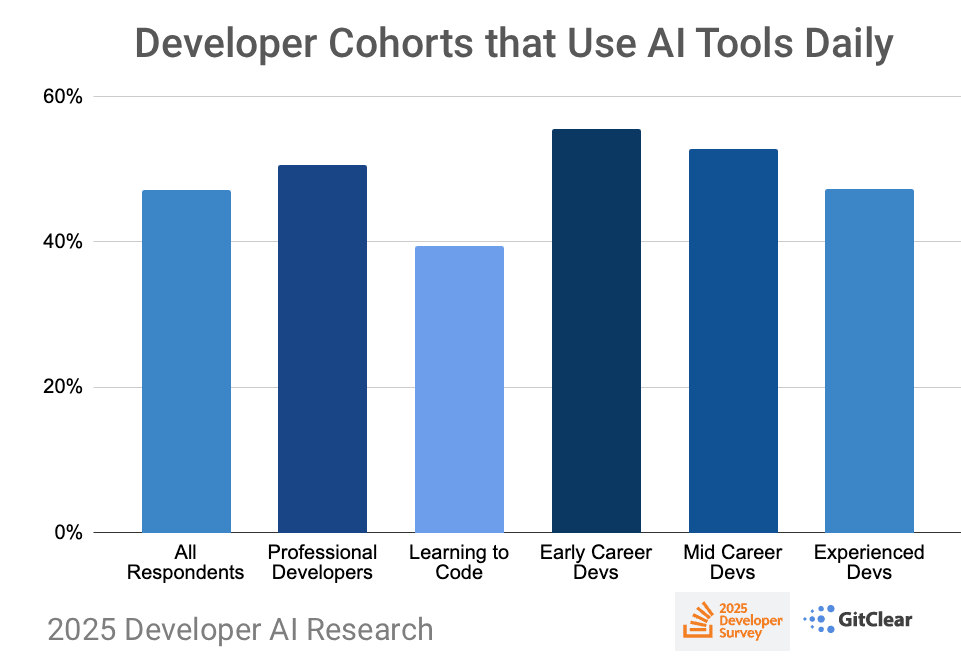
As measured by 33,662 respondents to Stack Overflow's 2025 Developer Survey
See how the left and right column are nearly identical in value? It seems that "Experienced Developers" are pulled toward AI by having great pressure to deliver high-volume, high-quality code, and pulled away from AI, one supposes, by "entrenched habits/workflows." The forces offset and "Experienced Developers" net a perfectly average attitude toward AI tools.
More puzzling is seeing the "Learning to Code" cohort trail the pack. I would have expected that cohort to be the most avid AI users, since they have the most to gain from AI, relative to their experience. The "Early Career Devs" reflect the high usage that I would have expected to see reported by the "Learning to Code" segment.
My only guess is that perhaps respondents chose "Learning to Code" as their "experience level" when they were hobbyists, scientists, or other professionals with no aspiration to become a "full-stop" Software Developer. Still, even if this group doesn't plan to "go pro," and even if they are ambivalent about programming in general, it's surprising that they would not lean toward augmenting their own capacity with the best tools. Maybe they don't feel confident that they can evaluate the results they receive? This is a vexing data point in an otherwise-illuminating breakdown.
Here are the links to the surveys from which these data points were extracted:
2022 | 2023 | 2024 | 2025 | |
Stack Overflow: | 0% | |||
JetBrains: | 0 | Pending release as of Oct 2025 - will update upon release |
linkWhat do Developers Want to Delegate?
"Just let me write some code" is the hope & intent of today's developers, as they work under the growing shadow of "AI Agents that can plausibly handle multi-hour implementation tasks." Nestled within their general desire to "write some code," we can find several shades of nuance. Because, come to think of it, maybe those job-stealing AI Agents wouldn't mind taking a first stab at triaging the bug just got posted to Slack for urgent attention...
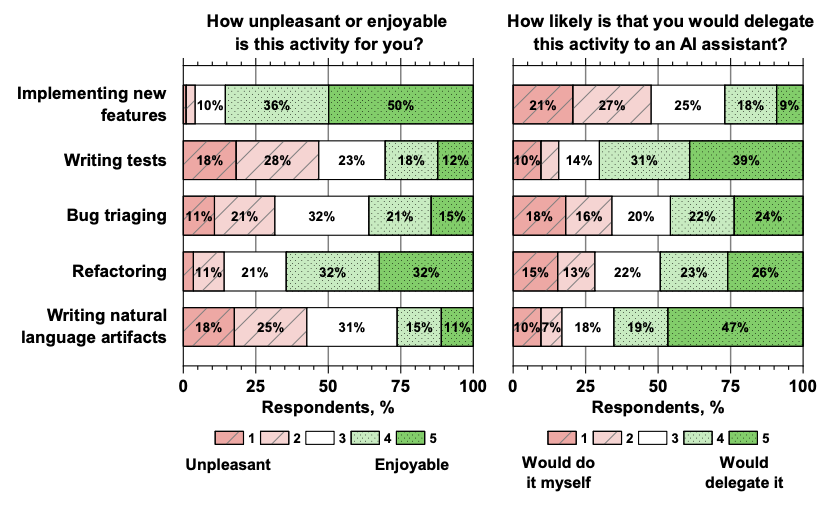
Take the features. Leave the bugs
I love that Jetbrains thought to split developer sentiment into such interesting buckets! We are all richly rewarded for their inspiration by getting to see such clear divergence of attitudes depending on the type of programming task.
These graphs prove a truth that's palpably felt by any professional developer: the fun part of the job is implementing new features. You get the spark of imagining how your implementation will delight some target audience, plus the satisfaction of seeing code spring to life on a device. A+, would code it every day if possible. The data proves that fully 86% of developers find "Implementing new features" to be "Enjoyable" or "Very enjoyable."
On the opposite side of the spectrum, developers do not care for "writing tests," "bug triaging," or "writing natural language artifacts." It looks like "writing tests" is the single most-synergistic area where developers are ready to hand-off responsibility, and AI is likely ready to step in and meet that need, given that the naturally duplicative tendencies of modern AI are less of a liability in test code than in other domains.
linkWhat Sort of Tasks do Developers Actually Delegate to AI Assistants?
A final lens through which to contemplate the role of AI agents in coding is to consider "what do developers trust them to get right?" These results come from the most recent Jetbrains survey:
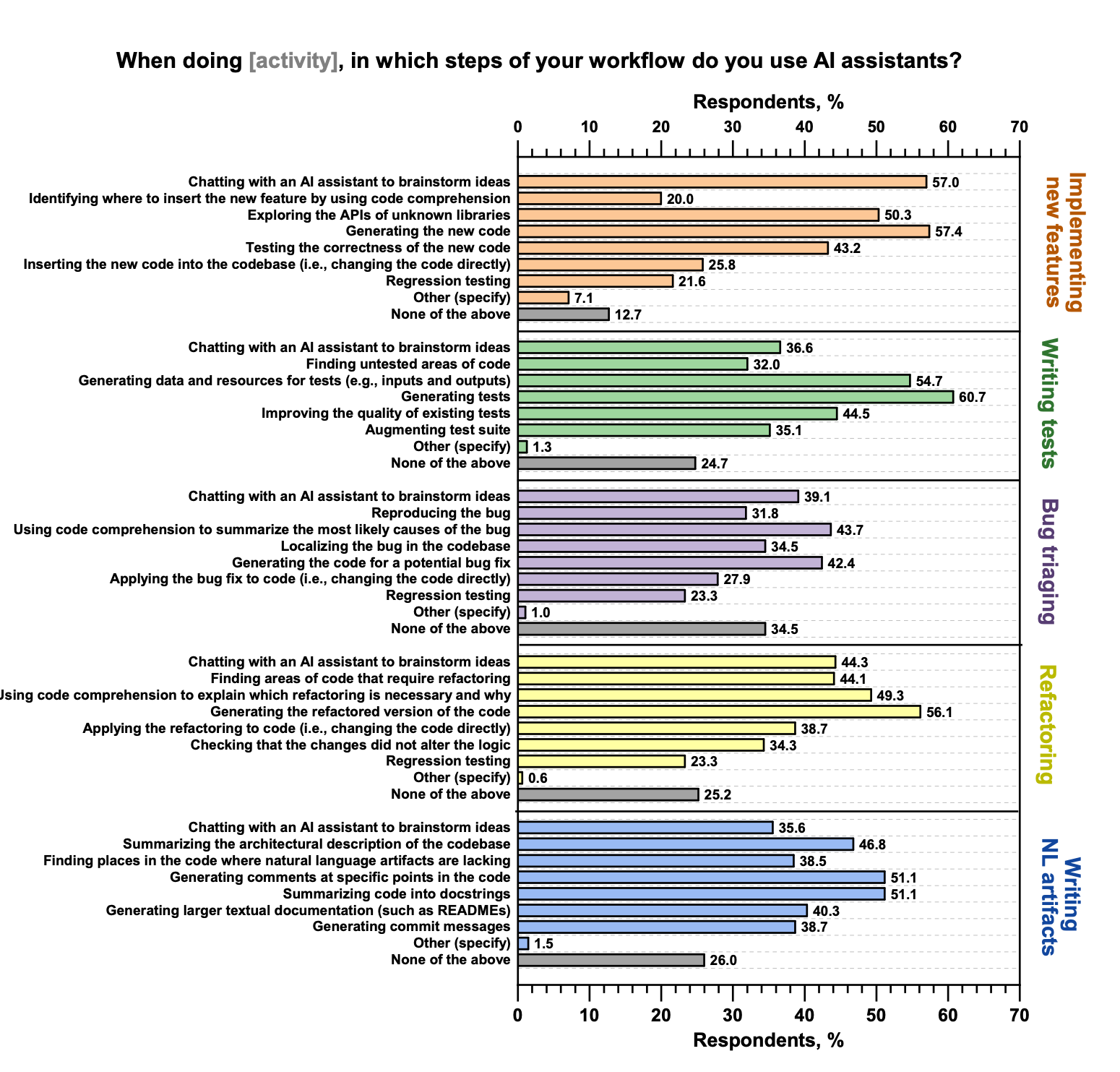
Data from Jetbrains' Arxiv-published paper, What would you use AI to accomplish?
Though the previous chart showed developers savor the process of implementing new features, it's interesting to note that 57.4% of respondents indicated that they use AI to "Generate new code" when working on a new feature implementation. Apparently, having an affinity for a task is not mutually exclusive with being willing to delegate it, at least in part.
The single largest point of delegation for AI was "Generating tests." Not surprising, given the results from the previous section, which proved that working on tests was foremost among areas that most developers felt they could do without.
linkAI Research Sources
Below are the surveys that were canvassed to compile the charts above. Not all of these surveys qualified to be included in the graphs, but they do help inform the broad question of "How rapidly is AI being adopted in the software development category?"
Stack Overflow 2025 Developer Survey. https://survey.stackoverflow.co/2025/ai – 84% of professional developers report using AI tools at least monthly (including infrequent use), and 65% use them at least weekly survey.stackoverflow.co survey.stackoverflow.co.
Stack Overflow 2024 Developer Survey. https://survey.stackoverflow.co/2024/ – 76% of developers were using (or planning to use) AI tools in their development workflow (at least infrequently), up from 70% the previous year heise.de.
Stack Overflow 2023 Developer Survey. https://survey.stackoverflow.co/2023/ – 70% of all developers reported that they use or plan to use AI tools in their development process survey.stackoverflow.com. (Those “learning to code” showed even higher adoption at 82%survey.stackoverflow.co.)
JetBrains State of Developer Ecosystem 2024. https://www.jetbrains.com/lp/devecosystem-2024/ – 49% of developers surveyed regularly use ChatGPT for coding (69% have tried it), and 26% regularly use GitHub Copilot jetbrains.com jetbrains.com.
JetBrains State of Developer Ecosystem 2023. https://www.jetbrains.com/lp/devecosystem-2023/ – 77% of developers said they use ChatGPT, and 46% use GitHub Copilot (at any frequency) as of 2023 jetbrains.com. (This was the first year JetBrains surveyed AI assistant usage.)
DigitalOcean Currents Survey 2023. (DigitalOcean Currents is a survey of developers at small-to-mid-sized tech companies.) According to the 2023 report, 73% of respondents were actively using AI/ML tools for personal and/or work projects digitalocean.com.
DigitalOcean Currents Survey (Feb 2025). (1,000+ developers surveyed) – 79% of developers said they are already using AI in some capacity (though many are still in early exploratory stages) digitalocean.com. This underscores that a large majority of developers “regularly” incorporate AI tools or services as of 2025.