
linkQuick Reference
linkHow do I install the plugin?
Quick note: Amplework works only if you are on the Pro or Unlimited plans of Amplenote, because it needs access to the sidebar note viewer.
linkFeature reference: how do I do things in this plugin?
Please scroll down to Work cycles, in short if you would like an explanation of the method. Keep reading this section for a quick feature reference of the plugin. Alright, let's dive in!
linkHow do I start a new session?
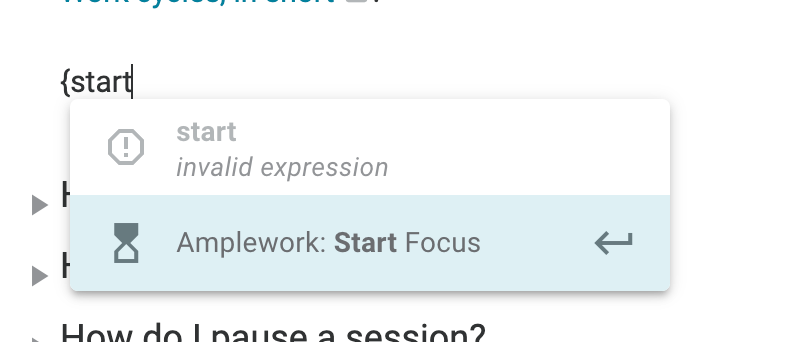
Open your Daily Jot and type in the curly bracket { followed by "Start Focus". Note that most likely you can get away just with typing {start before the menu suggests this plugin. Hit Enter and the plugin will be triggered. Follow the instructions for setting a start time and the number of cycles you want to focus for. If you don't know what a cycle is, please scroll down to Work cycles, in short.
linkHow do I end a cycle early?
Let's say you finished your target 2 minutes early. You don't have to wait for the timer to reach zero before you can write down your session debrief. Instead, you can just click on the button in the sidebar interface:
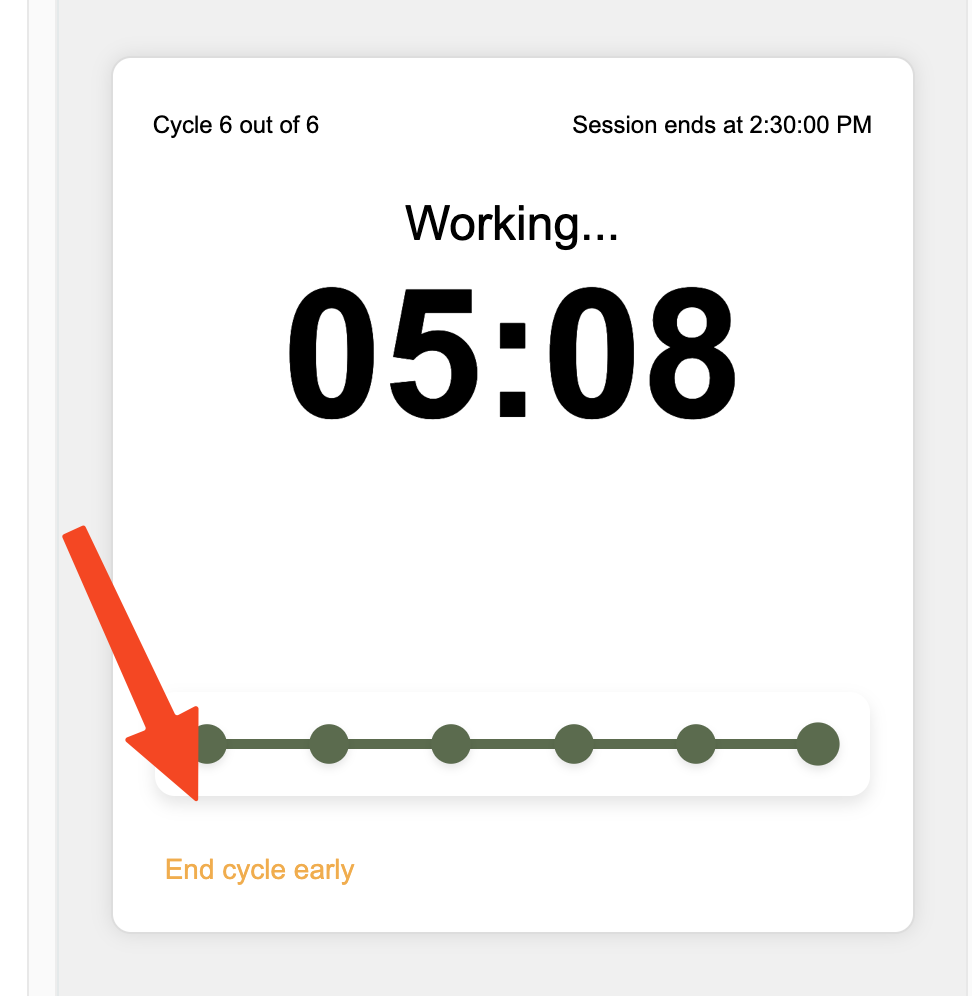
This will end the current work cycle, it will ask you for completion, morale and energy values, and it will enter cycle logs in your Daily Jots for you to complete.
linkHow do I cancel a session?
To cancel a session, feel free to just abandon it and let the timer run out. Alternatively, you can refresh your page/restart your client.
linkHow do I pause a session?
You cannot pause a session. The philosophy of this method is that you are supposed to timeblock 4 uninterrupted hours on your calendar ahead of time. The most benefits from this method come when you do deep work for an interrupted block of time.
That said, please reach out to the plugin creator and submit your feature request! If enough people start needing this, it will get added!
linkWhat is the sidebar interface and how is it useful?

linkWhat are session logs and how do I use them?
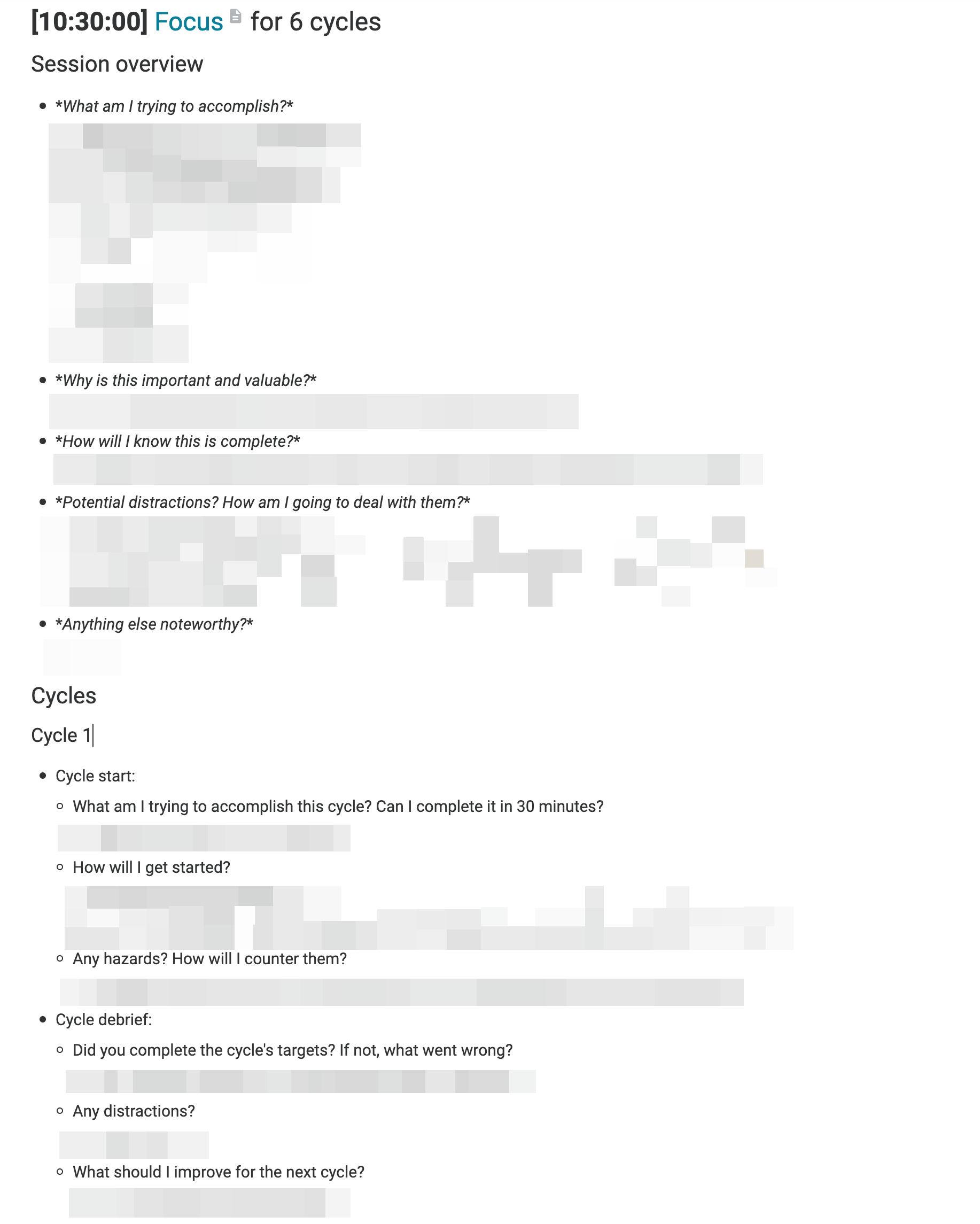
Session logs are what gets inserted into your Daily Jot. Before and after each cycle, the plugin will automatically add some prompts/questionnaires for you to answer. Make sure to not edit the structure of these propmts (eg. delete or edit heading names), but instead only add content around it. The plugin is smart enough to not overwrite other content and always append to the correct cycle heading.
linkWhat is the Focus note and how do I use it?
The "Focus" note is a note created that helps group together all of your sessions. Visit that note and scroll down to the backlinks tab to see a list of all of your focus sessions ever.

linkWhat is the Focus Dashboard and why do I need to never edit it, no matter what?
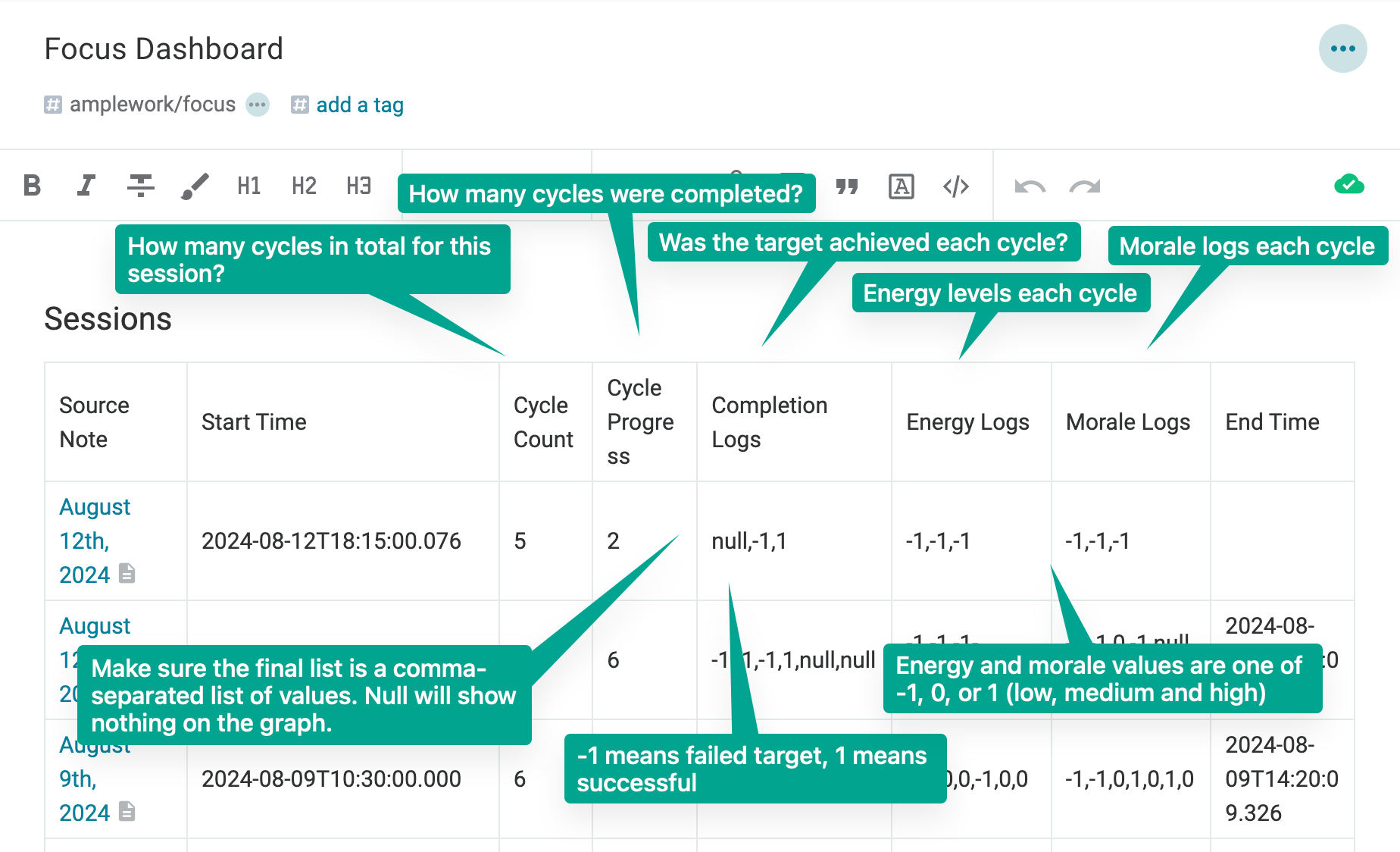
The Focus Dashboard is a the "Database" for this plugin. It stores a history of all of the focus sessions you do, logging stuff like cycle completion values, energy and morale. Avoid editing this note, unless you know what you are doing.
linkHow do I reopen the sidebar timer after closing it accidentally?
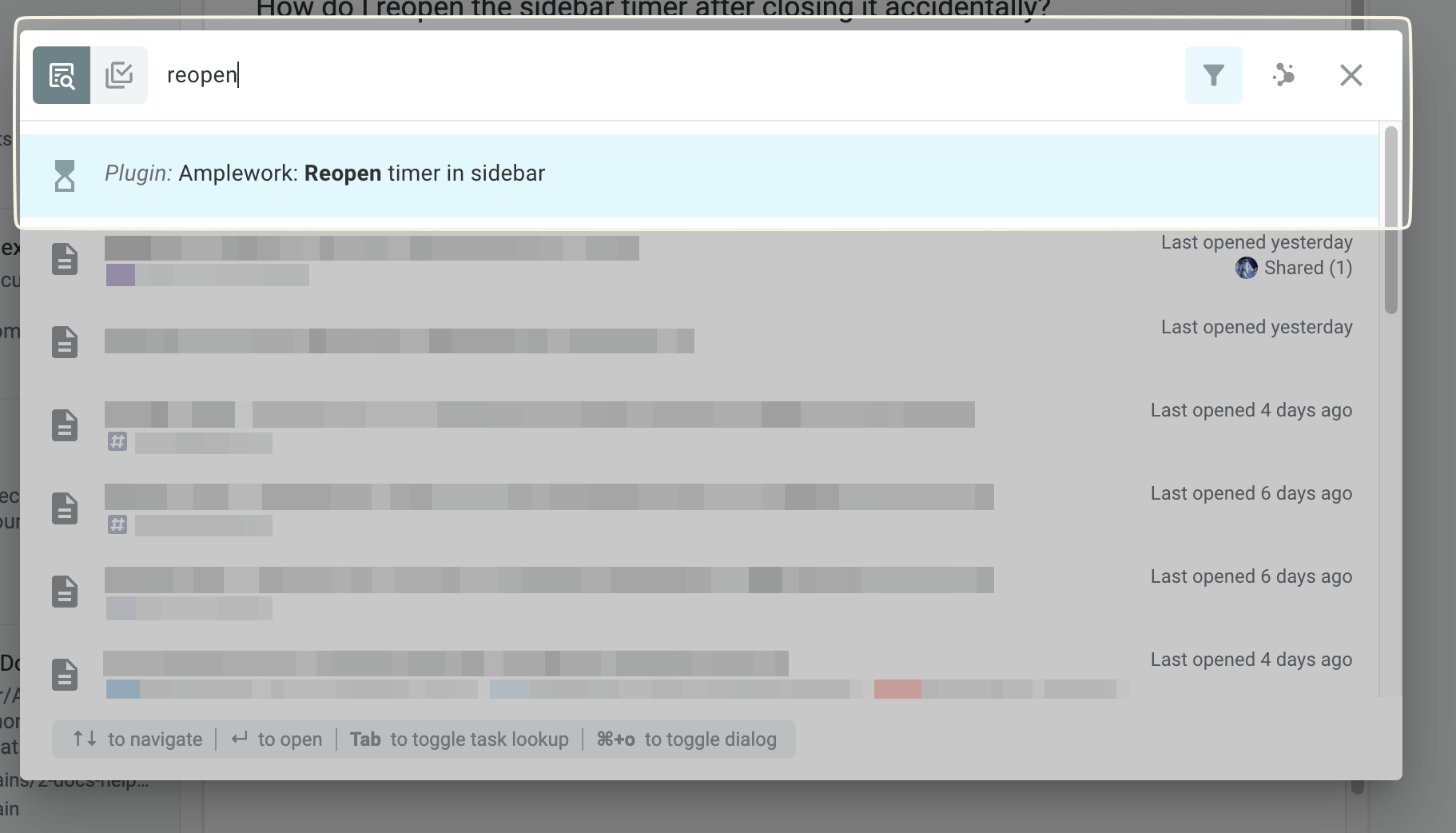
To reopen the sidebar interface, hit Ctrl-O or Cmd-O and type in the words "reopen timer in sidebar", then press Enter.
linkHow do I change a value for morale, energy or completion?
Navigate to your Focus Dashboard note and find the value that you need to edit. Make sure you are not breaking the format of any cell, because that might produce errors.
linkWork cycles, in short
Hey, friends! "Work cycles" is a way of working I have discovered through Ultraworking. All credits go to Sebastian Marshall and the amazing people at Ultraworking for introducing this to me. If you're curious about the method and how to use the corresponding Amplenote plugin, you're in the right place!
I've discovered "working in cycles" in 2021 and it has helped my output and concentration significantly. Work cycles are like a "pomodoro timer" with some extra features built on top. They introduce a bit of structure into your work routine, in a way that helps you avoid distractions and become "better at working" in general.
The method is very straight-forward. You set a timer for 30 minutes of uninterrupted focus, where you try to complete as much of your task. In between each work cycle you take a 10-minute break, where you review your progress and plan the next 30 minutes. Repeat this for however many cycles you want (but 6 cycles is the sweet spot).
linkWho is this for?
Work Cycles are not for everyone. I think you should try working in cycles if you meet at least some of the following:
Time blindness: you work for 8 hours and you cannot account for how you spent that time
You have trouble sitting down and focusing on your work for long stretches of time
You are interested in obssessing over iterative 2% increases in your productivity
You work from home/remotely and rarely interact with other people
You need a structure to improve ergnomics and healthy habits around working
You actively want to get better at planning work
You frequently benefit from shared accountability
linkTaking breaks
Working in cycles has some big advantages that I will attempt to explain below. If you're unsure whether this is for you, this next bit should very much elucidate that.
For one, taking frequent breaks from working is pretty much non-negotiable. The work-break format of this method acts as a reminder for you to stand up from your chair and rest your eyes. Also, I have found that working in cycles balances out those days when I feel less motivated, because it allows you to visually keep track of your progress.
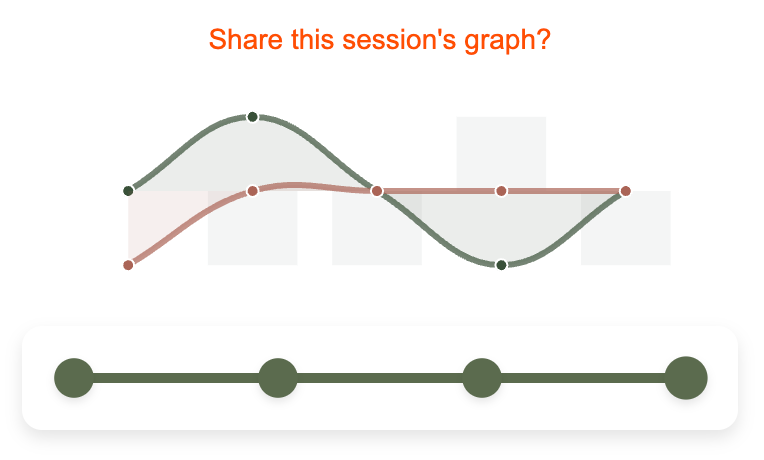
Funnily enough, on a day with very high motivation, work cycles are great to ease off the gas and make sure you don't work yourself into a burnout.
linkGit gud (at working)
But I would say that the most impactful bit of working in cycles is that it forces you to "think in 30-minute blocks". Let me explain what I mean. When someone asks you "how long will this take", how do you answer? You might be inclined to say "this will take 2 days" or you might be confident enough to say "16 hours", but where does that number come from?
In reality, most of us eventually get pretty good at estimating stuff by virtue of doing that "stuff" frequently. Familiar work feels easy to approximate, because we have so much experience with it. But it's the "unfamiliar work" that is trickier. If you've never written a book before, how do you guesstimate how long it will take to write and edit a chapter?
Planning and reviewing my work every 30 minutes has helped me start "thinking in cycles", which helped me answer questions I wouldn't normally stumble into:
What distracted me from staying focused?
Did assume that no problems will come up?
Did I make a good plan but forgot to actually stick to it?
linkEnergy and morale
The other mental model that I really like is "energy vs morale". After each work cycle, the method asks you how you are feeling physically (energy levels) and mentally (morale levels). Tracking your energy and morale levels separately helps you figure out what the real problem is when you are stuck or "don't feel like doing" something. For example, if you realize that you are currently low-energy, you can return to your work session after going for a walk, or taking a shower. If your morale is low, you can break down your task into smaller sub-tasks, or you can pick a different project altogether, perhaps one that gets you more excited.
It is also rather interesting to see how your morale levels change once you are into a work session. For most people, morale tends to go up after properly framing the work that they have to do and then doing that work for two or three cycles.
linkAmplework, the plugin
You could easily use a timer and pen and paper for work cycles. But instead, I suggest using the Amplework plugin.
‘
linkStarting your first session
Whenever you want to start a new work session, the first thing you should do is to block some time on the calendar. If you're focusing for 6 cycles, that rounds up nicely to 4 hours, so take a look at your obligations for the day and try to find the slot that lets you focus for 4 uninterrupted hours.

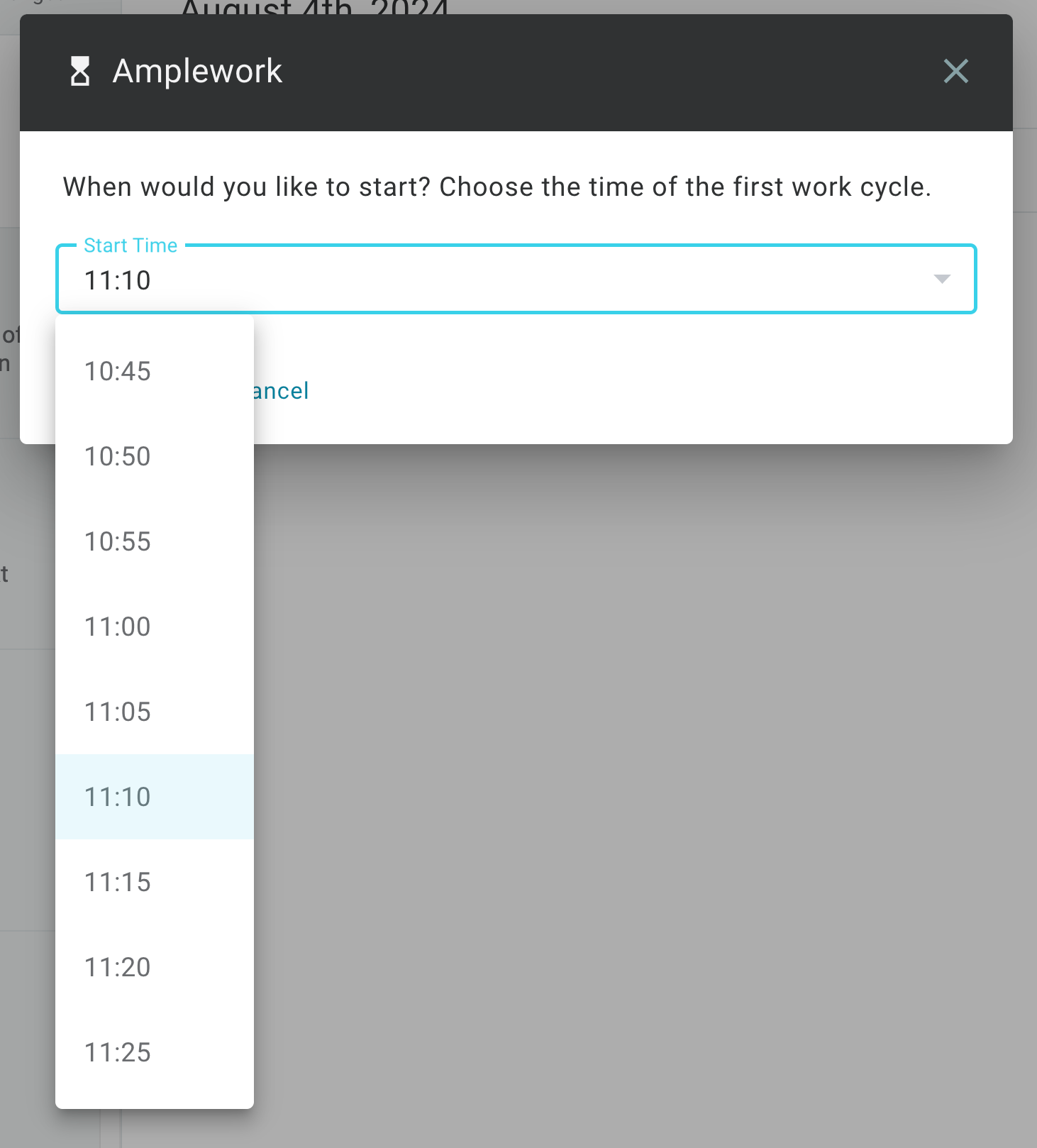
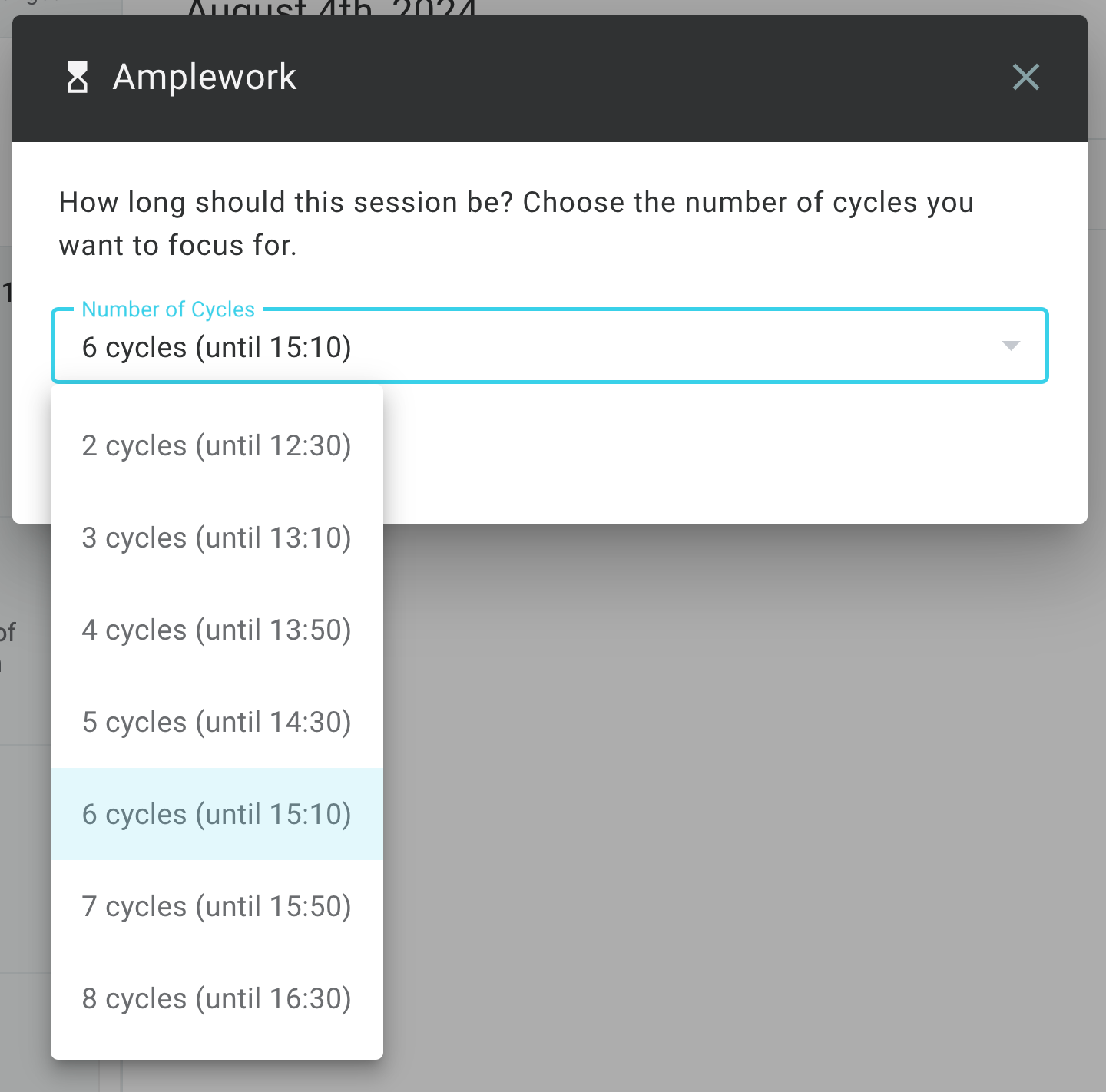
To start a new session, open up your Daily Jot and type in {start focus}. The plugin will prompt you to choose the time you want your first cycle to start at, as well as the number of cycles you want to focus for.

When you choose your start time, try to allocate at least 10 minutes before the first cycle starts for planning your work. Planning your sesions is probably the most crucial bit for having a successful session, so I recommend you don't skip this part. Once you choose a start time and the session duration, you are ready to start!
 |  |
The first thing you will see now is a prompt to record your energy and morale levels. You will see this prompt again after each individual cycle.
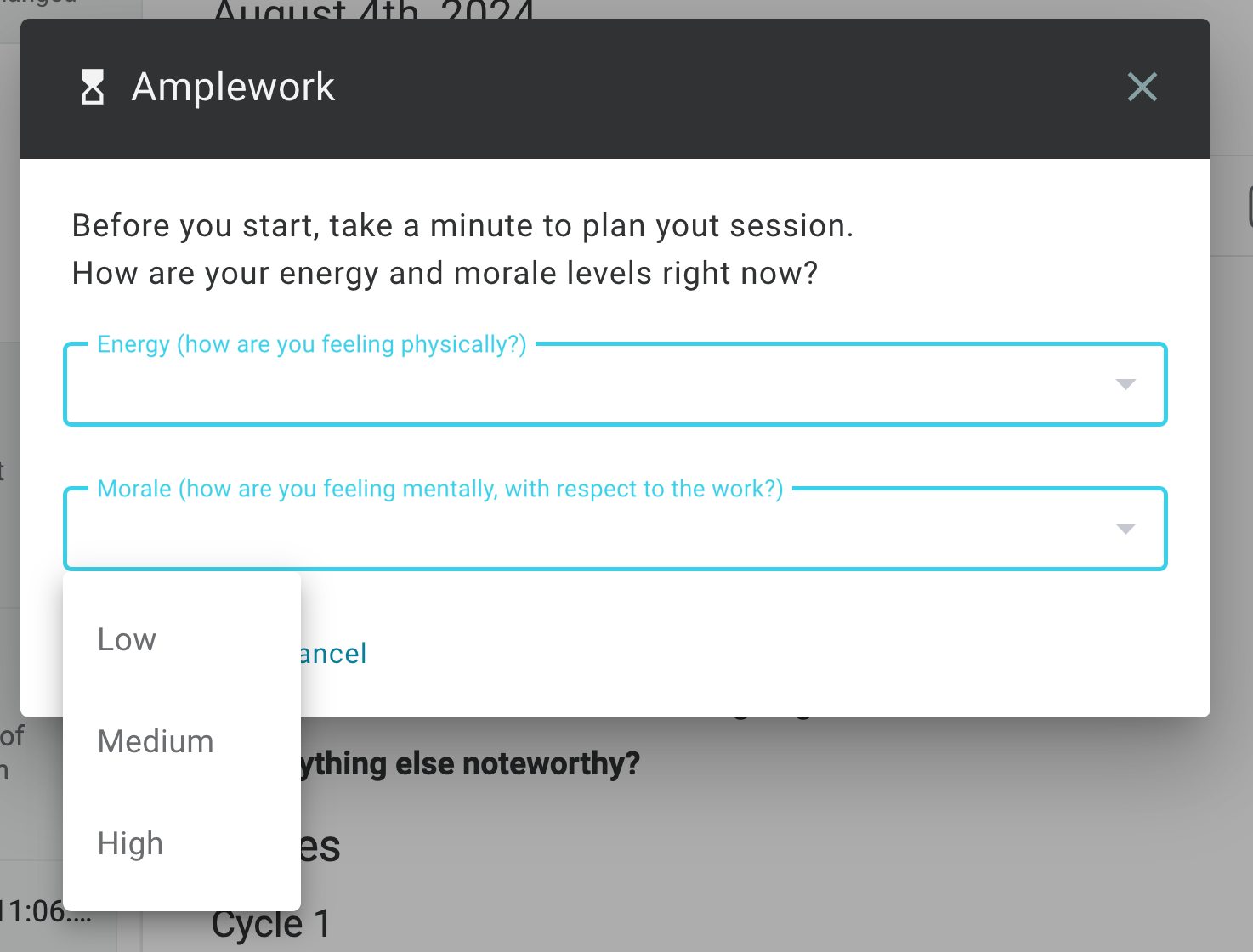
Your "energy" is what your body feels like at the moment. If you're not sleepy or tired, if you're not ill or feeling any pain and if the room is neither too hot or too cold, that means your energy is "high" and you are good to go!
Your "morale" is your mood as well as how positively you relate to the work that you have to do next. Your morale is "low" if you are distracted, worried, sad or simply not very excited about the tasks on your list. When you fill in the prompt for energy and morale, try to give it at least a good 30 seconds.
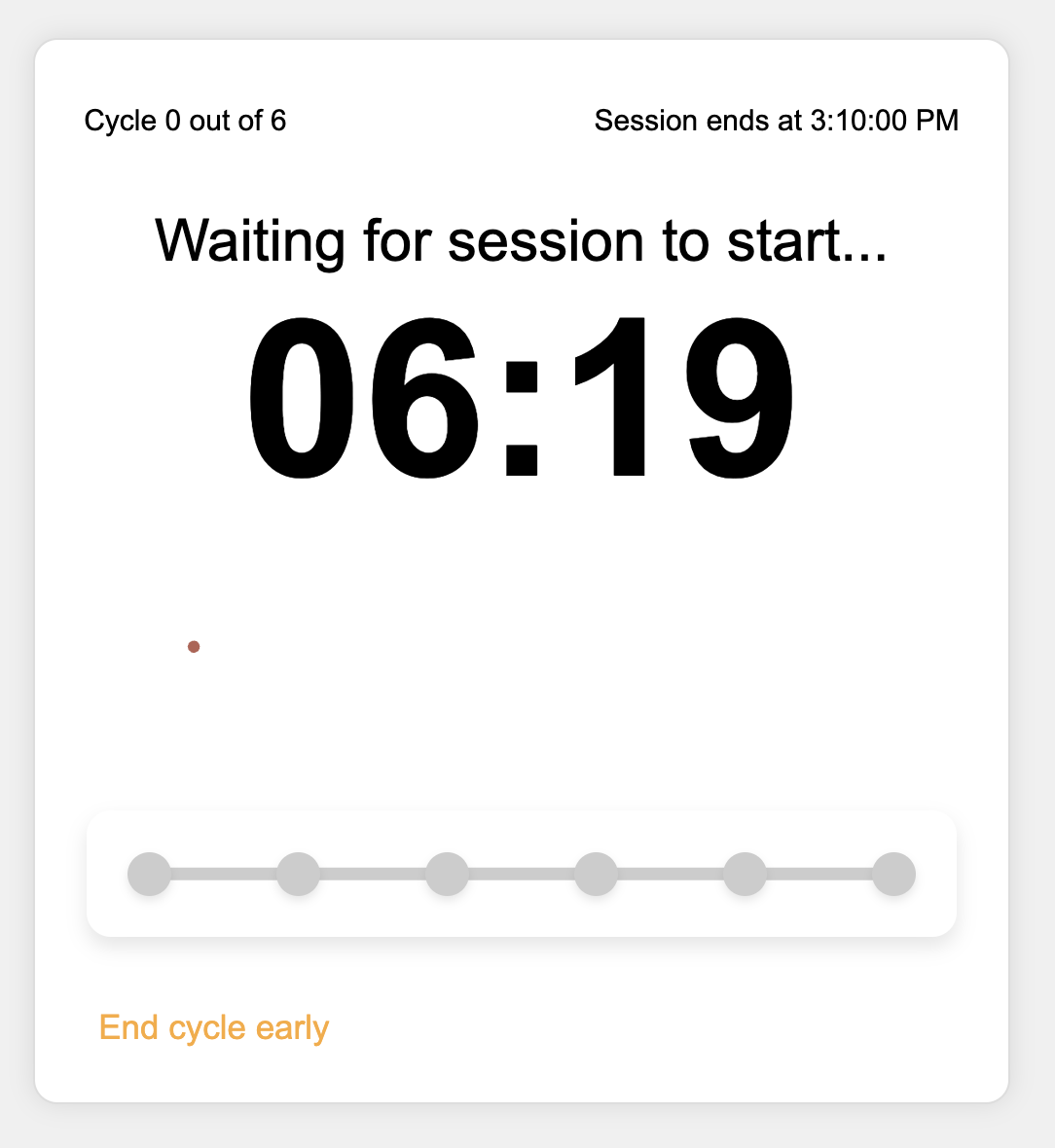
With your energy and morale levels recorded, the plugin will now ask you to plan your session to begin with, then your first cycle after that. At this point you might also notice the Amplework interface being open in the Peek Viewer.
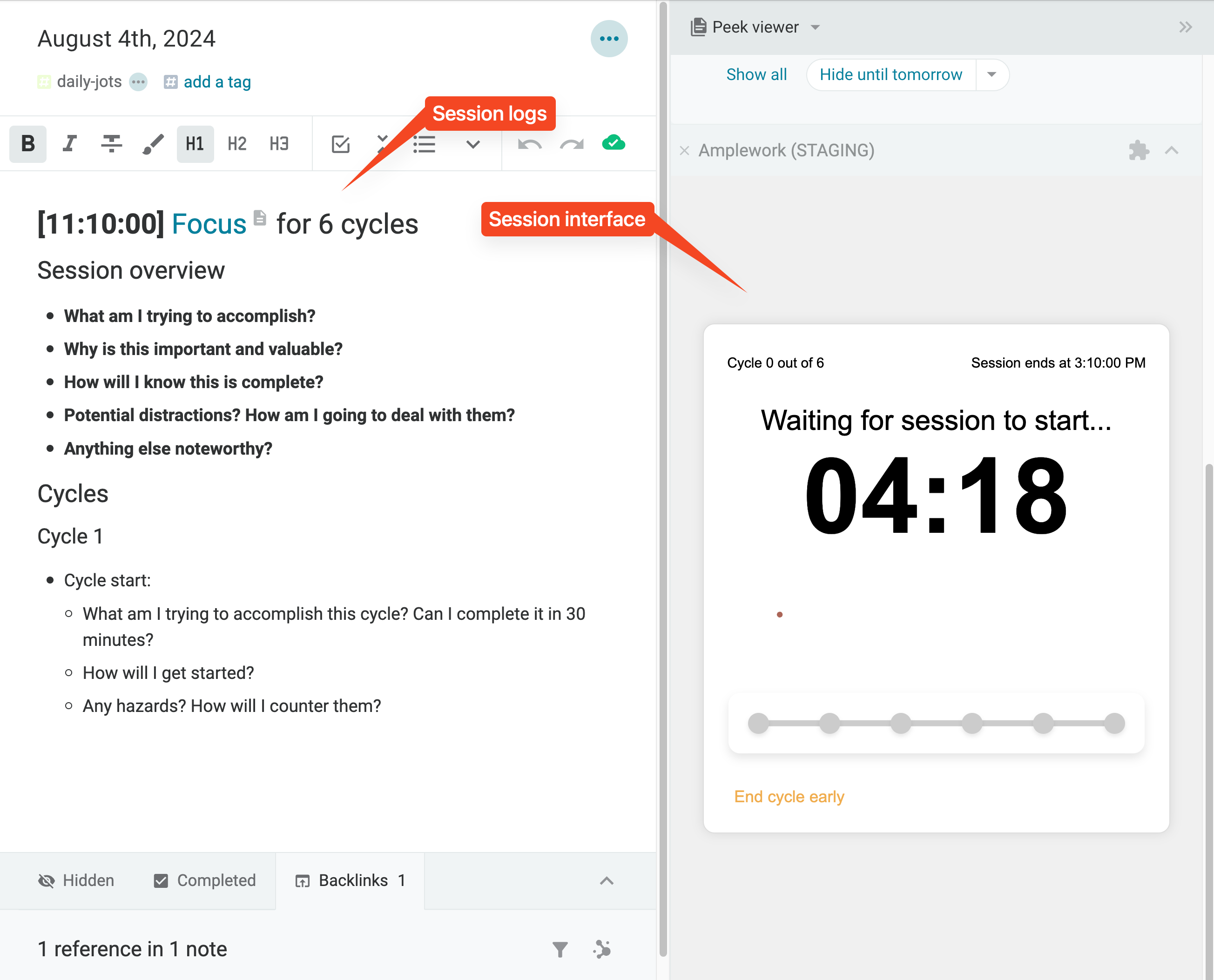
Right now you will hopefully still have some time left before you first cycle starts, so let's use it to plan the current session.
linkWhat am I trying to accomplish?
After logging your energy and morale, your daily jot will be populated by the Session Start questionnaire.
The first question essentially asks you to create a plan for the entire session. Feel free to use that space to brainstorm, write to-do lists and triage tasks until you are happy with your plan. While you craft your plan, try to keepin in mind the number of cycles you chose to work for. Can you get your work done in that amount of time?
In addition to the time constraint, try to anticipate what could interrupt your sesion. Ideally, you would schedule your session such that it doesn't overlap with other obligations.
When you write your targets for the day, try to be as precise as possible. "Work on the paper" is good enough for describing what you are doing if your family asks, but insufficient for our cause. "Edit the abstract" is better, because it narrows down the scope of your work. "Edit the abstract by shortening sentences, proof-reading and rephrasing the informal stuff" is even better, because it sets the standard for what the finished product should look like.
What to do if you don't yet know what the plan is?
linkWhy is this important and valuable?
This question can quickly get old and it might be tempting to skip it, but the more you stick to outlining exactly why it is that you are doing something, the more successful your work sessions wil be.
When answering this question, try to think:
linkHow will I know this is complete?
In this section, try to write down the "win condition" for this session. If you're redesigning a landing page, what are the exact elements you would like to change? If you are coding a new feature into an app, what is the complete list of things the user should be able to do that were impossible before?
When thinking about the standards for what you are going to do today, it is good to consider whether those standards are subective or open to interpretation. Your standard for the day may well be "write an article that would make some of my friends smile", but it's good to acknowledge it when there is no absolute "definition of done".
Finally, try to determine if you want to work up to a certain time or certain quality.
Time | Quality |
I will stop polishing my landing page next friday, no matter how good it is, and I will ship that version. | I will stop working on my website when the load time is under 0.2ms on Internet Explorer. |
linkPotential distractions? How am I going to deal with them?
For this question, try to list all of the things that might go wrong. Are you feeling particularly distracted today? Is your family visiting? Are you going to be thirsty soon, or do you need a quick snack until the next meal? How can you prepare for those situations such that you minimize or avoid them completely? Write down all of your reasoning in this section.
linkStarting your first cycle
Now that your session is laid out, it's time to pick the work for the first cycle.
linkWhat am I trying to accomplish this cycle? Can I complete it in 30 minutes?
For this prompt, pick the first objective that you can do in 30 minutes or less. Just like when you are designing the plan for the entire session, try to be as specific as possible.
Can you complete that thing in 30 minutes or less? If you're tackling "new work" that you don't have much experience with, it can be almost impossible to know ahead of time. But if you want to get better at planning, you have to get better at predicting the future.

How much would this target take me if everything goes perfectly as planned and no problems arise? How much will it take if something goes wrong at every step? Assume reality will be somewhere in the middle.
linkHow will I get started?
When we think about our work, we may be under the impression that we understand it completely, but sometimes the first steps are more ambiguous than we realize. This question test how well we understand the goal we set ourselves. Give a good answer to this question and you might double your morale levels.
For example, if your task for the current cycle is "come up with a list of keywords for the next blog articles", your could start by "opening Google Keyword Planner and write down the top 3 keywords for our biggest 5 competitors".
linkAny hazards? How will I counter them?
For this question, try to think about the nature of your task and how distraction-prone it is.
At this point, feel free to use the rest of the break to do something else, but make sure to return before the first cycle starts.
linkThe work phase
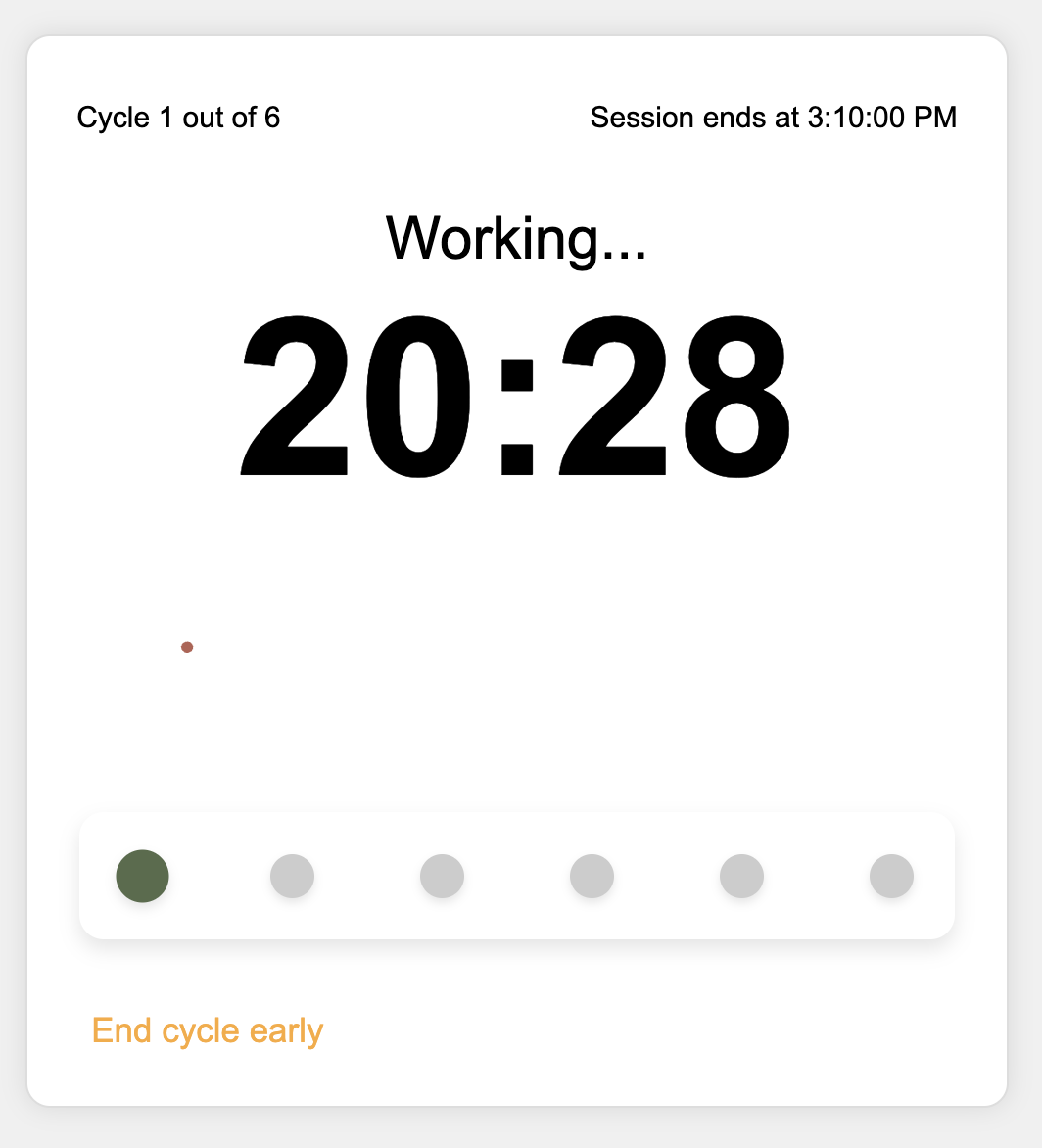
During the cycle itself, your only job is to keep focused. Right now might be a good idea to put your phone away. 28 minutes into your cycle, you will hear a bell sound, to remind you to wrap up whatever you are doing, such that you can pick up seamlessly come next cycle.
linkDebriefing
After your first cycle, you will be asked to debrief. The debrief includes the morale and energy logs once again, and you will also be asked if you completed the target you set for the previous cycle. Check the box if you finished your target, leave it unchecked otherwise. Don't worry about a failed target. As you will soon see, the system is "self-healing".
Next, your daily jot will be populated with a debrief questionnaire.
linkDid you complete the cycle's targets? If not, what went wront?
According to your definition of done, did you manage to complete all of the items you listed for the first cycle? Here are a few helper questions to consider:
I finished everything on my list: was my plan too pessimistic?
I completed less than half of my target: was my plan too optimistic, or was I too distracted during this cycle?
Did I do things that were not planned? And was it a good idea to stray from that initial plan?
Do I need to change anything about my session-wide plan? Perhaps I can reduce the scope of my work, or work on something else altogether?
linkAny distractions?
Look back on the past 30 minutes and determine if there was anything that broke your focus. Can you reduce these distractions during the rest of the session?
linkWhat should I improve for the next cycle?
Anything you think can be applied in future cycles, but it helps to think of the small stuff. Maybe all you need is to have a glass of water next to you, or maybe you can "start using tab groups in Chrome when researching more than 10 pages at once".
linkThe next cycles
After your first cycle debrief, the pattern repeats. You plan the next cycle, take the rest of the break off, and so on. Do this a number of times equal to the cycle target you set, and your session is done.
When that happens, and after entering the last energy and morale values for the session, you will be encouraged to write a session debrief.
linkThe session debrief
This bit is another one that feels unimportant and easy to skip, especially when your work is done and you just wanna chill for a bit. But I recommend you fill these in every time, and you will see much better results in general.
linkWhat did I get done in this session?
Take the time to write down the things you got done and make sure to highlight what you weren't able to finish.
linkWhat should I work on during the next session?
Where should you pick up next time you do a session?
linkDid I get bogged down? Where?
Probably the second most important field of the session. The better you become at observing what prevents you from completing your plan, the better you become at working in general.
linkWhat went well in this session? How can I make sure to replicate this in the future?
Probably the most impactful question. Make a list of the various things that improved your energy and morale for the session. Try to write down how you felt about the work, which parts you liked, and how you got over the bits that you didn't like. What were the small things that made sgnificant differences?
Work cycles are about reviewing often and applying lessons. Completing questionnaires might not "feel like work", so you might be tempted to skip them. After all, working in cycles and taking breaks every 30 minutes is already better than nothing. And that may well be true.
That said, I strongly recommend you consider these questions deeply during every session, giving truthful answers every time. Do that and you will stumble upon things that you otherwise wouldn't have paid attention to, thus improving your focus by 1% every time you do so.
linkConclusion, assorted thoughts and further reading
Future versions of the Amplework plugin will be customizable, such that you can add your own questions and customize work and break durations.
If you have any more questions, find us on the work-cycles channel on our Discord.